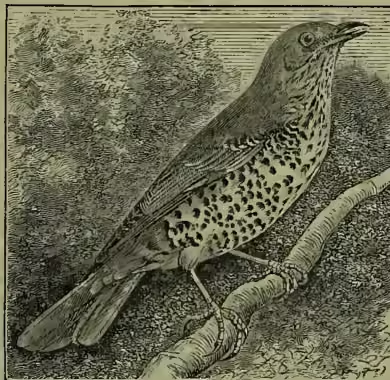
Thrush (Turdus), a genus of Passerine birds of the family Turdidae. The bill is of moderate size and slightly convex; the gape is furnished with hairs; the nostrils lie at the base of the bill, partly covered by a membrane; the first wing-feather is very short; and the outer and middle toes are connected at the base. The genus includes numerous species widely distributed throughout temperate and even cold regions. The largest known British species is the Missel Thrush (T. viscivorus), sometimes called the 'storm-cock' from its habit of singing before or during wind or rain. It breeds freely throughout the British Islands, but migrates from the colder regions on the approach of winter. It breeds early in the year; its nest is usually in the fork of a tree, and neatly lined with grasses and moss. The adult male measures about 11 inches; the prevailing colour of the upper parts is grayish brown, under parts brownish white, with dark spots.
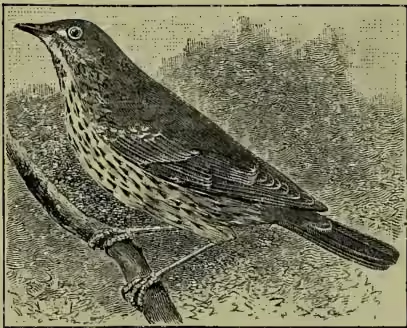
The Song Thrush or Mavis (T. musicus) also occurs in almost all parts of Britain. It resembles the missel thrush in general appearance, but is smaller in size, of a more olive-brown colour, and possesses finer powers of song. The nest of the song thrush is usually composed of roots and grasses, lined with a thin coating of mud, decayed wood, or dung. The eggs are of a greenish-blue colour, with black or brown markings, and in the warmer parts of the country two broods are reared in a season. The food of the song thrush consists of berries, insects, worms, and small molluscs, the shells of the last being broken by repeated knocking against a stone. Other species either resident in Britain or visiting it for a part of the year are the Blackbird (T. merula), the Fieldfare (T. pilaris), the Redwing (T. iliacus), and the Ring-ouzel (T. torquatus), all of which are described in separate articles. The genus Turdus is represented in North America by the Wood Thrush (T. mustelinus) and several other species. The flesh of all the thrushes is esteemed a delicacy, and they are snared in enormous numbers while they are assembling for their winter migration.