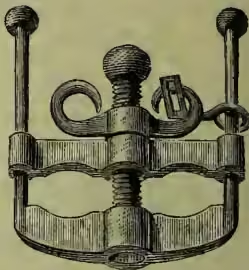
(In Ant. Mus., Edinburgh.)
Thurlow, EDWARD, BARON, was born a clergyman's son in 1732, at Bracon-Ash in Norfolk. He was sent to Canterbury grammar-school, whence he passed to Caius College, Cambridge. Here he was as insolent and insubordinate as at school, and was sent down in 1751 without a degree. He at once entered at the Inner Temple, and was called to the bar in 1754. He was a fellow-pupil in a solicitor's office with the poet Cowper, and still affected idleness, although in reality he worked hard to make himself a good lawyer. His lofty stature, strongly marked features, dark eyes, bushy eyebrows, and look of self-possession led every one with whom he came in contact to attribute to him qualifications he really did not possess—'no man,' said Fox, 'ever was so wise as Thurlow looked.' An accidental meeting at a coffee-house with the Scotch solicitors in the great Douglas case led to his employment in it as junior counsel, and to his acquaintance with the members of the Douglas family. One of them, the Duchess of Queensberry, by her influence with Lord Bute obtained for him in 1761 the rank of King's Counsel. Soon after this he acquired a still higher reputation by his speech in the Douglas Peerage case—the greatest effort of his life. In 1768 he was returned for Tamworth, and became a zealous supporter of Lord North; in March 1770 he was made Solicitor-general, and the year after Attorney-general. He gained the special favour of George III. by the violent zeal he displayed in supporting his American policy. In 1778 he became Lord Chancellor and Baron Thurlow, and such was his influence with the king that he was allowed contrary to all precedent to retain the office under the Rockingham administration. He caused great embarrassment by opposing all the measures brought in by that government. Under the coalition ministry of Fox and North he was compelled to retire, but continued a vigorous opposition, and was restored as Chancellor on Pitt's accession to power. For a time he supported the government; but, relying again on the support of the king, he once more began, first secretly, then openly, to undermine the power of his colleagues. Pitt then intimated that he or Thurlow must retire, and the king, without any hesitation, consented to his removal (1792). Thurlow at once sank into obscurity. He amused himself in reading the Latin and Greek classics with his nephews, and spent much of his time in visiting and receiving visits. He died at Brighton, September 12, 1806. Thurlow was vulgar and arrogant, his profanity and immoralities notorious. Lord Campbell says he can find nothing recorded of him to justify the great reputation for ability he had among his contemporaries, and ascribes it chiefly to his assuming manner; but it should be remembered that he had no Boswell to record his talk, and that it was this that was most admired. It was of no ordinary man that Johnson said, 'I would prepare myself for no man in England but Lord Thurlow. When I am to meet him, I should wish to know a day before.'