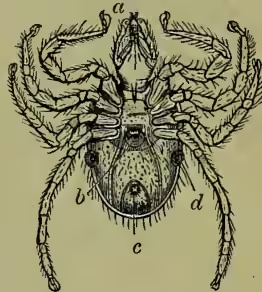
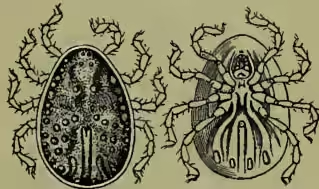
Ticks (Ixodidae), a family of mites (Acarina) the members of which attack man, cattle, dogs, birds, reptiles, and some other animals. They live in woods or among thick vegetation, and it is likely that their primary food-supply is derived from vegetable juices; but they are always ready to fasten on some passing animal, and are troublesome pests in tropical and semi-tropical countries. The mite-like body has a tough skin; there are four pairs of clawed legs; the mouth-parts consist (1) of a paired anchoring organ or 'rostrum,' covered with recurved hooks, and equivalent to a 'maxillary lip' or to the pedipalps of other Arachnids, and (2) of a pair of sharp mandibles which play backwards and forwards in two longitudinal channels on the rostrum.
Fastening themselves to the skin of an animal, they cut a hole and suck the blood. If allowed to feed till they are satisfied, they withdraw the rostrum and drop off. The sexes differ in appetite, the male being readily satisfied, while the female of some species sucks until, from an almost microscopic size, she becomes the greater part of an inch long. Yet some have been known to survive without food for at least four years. When the satisfied female drops off, she returns to the herbage and begins to lay eggs. Dr A. D. Michael says 'she places the eggs one by one in front of her in a pile or round ball, which gradually becomes almost as large as the mother-Ixodes. It is probably this position of the eggs which gave rise to the idea held by some of the earlier writers that the Ixodes laid their eggs through the mouth-opening; the fact being that the genital opening is very near the mouth, and the position during oviposition such that the mouth is not readily seen.' The typical genus Ixodes includes many species—e.g. the American White-spotted Tick
Ixodes albipictus and the European Ixodes ricinus; the blind genus Argas is well represented by Argas reflexus, common on pigeons; A. persicus, which produces troublesome punctures on man; and A. nigra, sometimes called 'the pique.' It is said that in warm countries the bites sometimes produce fevers, convulsions, delirium, and even death; but Méguin's experiments (in Europe) lead one to suspect that the danger of the bite has been much exaggerated. As the hasty removal of the tick is certain to leave the rostrum in the wound, the pest should be stimulated with a drop of turpentine or benzole.
The sheep-tick (Melophagus; see SHEEP-LOUSE) is a Dipterous insect, and to the same order belong the species of Nycteribia on bats and of Ornithonychia on birds. The 'death-tick' is a popular name for Pseudoneuropterous insects of the family Psocidae—e.g. Psocus, Cæcilia, and Clothilla—or for the little Death-watch (q.v.; Anobium).
See ACARINA; also A. Pagenstecher, Beiträge zur Anatomie der Milben (Leip. 1860-61); P. Méguin, Les Parasites et les Maladies Parasitaires (Paris, 1880); A. D. Michael, British Oribatidae (1884), and separate memoirs on Ticks.