Tides. To an observer on the seashore no phenomenon is more striking than the rise and fall of the water, the rhythmic ebb and flow which we know as the tides. Roughly speaking, the water reaches its highest level, or high-tide, twice each day, and similarly each day witnesses two low-tides. A little observation soon shows that the time at which high-tide occurs varies from day to day. Thus, if the high-tide occurred at noon yesterday it may not occur till one o'clock to-day. After the lapse of a week low-water will occur about the hour at which high-water was first observed, and high-water at the former time of low-water. When a fortnight has passed the times of high and low tide will be very similar to what they were when first noted, and so on regularly through the year. If these observations of the rise and fall of the tide are combined with lunar observations it will be found that high-water at any place occurs on the average a definite interval after the meridian passage of the moon. The close connection between the age or position of the moon and the time of high-water was recognised long before the true dynamical connection between them was discovered.
Close observation of the height of the tide from day to day will soon disclose the fact that this height varies. For example, on one particular day the tide will rise very high and fall very low; a week later the high-tide will come considerably short of the highest attainable, and the low-tide will not fall as low as the lowest attainable. After the lapse of another week the very high and very low tides will again occur, and so on, timing accurately with the four quarters of the moon. These extreme tidal variations are distinguished as spring-tides and neap-tides. Thus, at London Bridge the average range of the spring-tides is 20 feet 8 inches, that of the neap-tides 17 feet 3 inches. At Leith the corresponding numbers are 16 feet 4 inches and 12 feet 9 inches. Under certain conditions spring-tides rise very high, overflowing low-lying portions of towns and villages.
The general explanation of the phenomenon of the tides was given first by Newton. He supposed the ocean to cover the whole earth, and to assume at each instant a figure of equilibrium under the combined gravitation influence of earth, sun, and moon. The real problem is, however, a kinetic one, and as such was attacked by Laplace. Both the equilibrium and kinetic theories agree in explaining the broad features of the tides. Their results differ in important details, and neither satisfactorily represents the facts. There is no doubt, however, that the failure of the kinetic theory in this respect arises from our inability to take proper account of the configuration of land and sea, of the varying depths of ocean, and of the effects of fluid friction. It is impossible without mathematics to give any account of the kinetic theory. It must suffice to say that the problem consists in finding the forced oscillations of the ocean under the periodic tidal action of the sun and moon. Meanwhile we shall consider the faulty equilibrium theory, and see how far it explains the principal tidal phenomena described above.
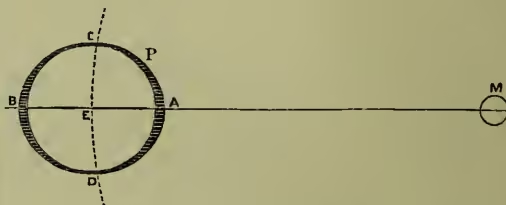
Let M be the centre of the moon, and E that of the earth. Imagine a sphere, CD, described with M as centre and passing through E. Then it is evident that all particles on the nearer side to the moon will be more strongly attracted than those on the farther side of this spherical surface. Thus, if A is the nearest point on the earth to the moon and B the farthest distant point, there will be a greater pull towards M at A than at E, and at E than at B. Again, at any point, P, which lies off the line ME, there will be a pull inwards towards ME. And thus, if fluid covers the whole surface APB, there will be a heaping up of the waters (relatively to E) at A and B and a sinking of them at C and D. The approximately spherical figure of the water-surface will be forced to take a spheroidal form, with greater axis pointing towards the moon. This form will follow the moon in its apparent daily course, and the result will be that twice every lunar day (24 h. 54 m.) high-tides and low-tides will be experienced at every point on the surface for which the moon rises above the horizon. This so far agrees with observation; but it is not found that in general the high-tide occurs simultaneously with the passage of the moon across the meridian. When it does, it is because the high-tide has, through the configuration of land and sea, lagged behind the moon by a whole half-day at least. At islands in the open sea or at ports looking eastwards across a broad ocean the time of high-tide is generally a few hours later than the meridian passage of the moon.
Now the sun as well as the moon will produce tides. The tide-generating power of a given body may be taken as proportional to the difference of the attractions exerted on the nearest and the farthest distant points of the affected globe. For example, if is the moon's mass, its tide-generating power will be proportional to (see GRAVITATION). But
Hence the tide-generating power will be proportional to the mass and to the inverse cube of the distance of the tide-producing body. Now the sun's mass is nearly 2,700,000 times the moon's mass, and the sun's distance is about 390 times the moon's distance. Consequently the sun's tide-generating power should be to the moon's in the ratio of 2,700,000 to —i.e. roughly, 5 to 11. At new and full moon the tides due to the sun and moon will fall crest to crest and trough to trough, and the total tide may be represented by . On the other hand, at times of half-moon the crest of the lunar tide will coincide in position with the trough of the solar tide, and the resultant tide may be represented by . Here we have at once the explanation of the spring and neap tides. In general the spring and neap tides do not differ by nearly so much as these numbers indicate. The spring-tide is seldom a half greater than the neap-tide. By the theory, spring-tides should occur at new moon and full moon, and neap-tides when the moon is in quadrature. In fact they occur about one and a half days later than the corresponding astronomical combinations.
As the moon passes through its first quarter the solar tide having a shorter period gradually shoots ahead of the lunar tide. For any position between new and half moon the crest of the resultant tidal wave will therefore pass a little sooner than it would if the moon alone were acting. Similarly for any position between half moon and full moon—that is, during the second quarter—the crest of the resultant tide will lag behind the position it would occupy were the moon the sole agent. In the former case the tide is said to prime and in the latter to lag. The same phenomena occur in the third and fourth quarters. This priming and lagging of the tide are very evident phenomena. Their effect may be readily observed by inspection of any table of tides, in which the intervals between successive high-tides will be found to vary considerably. As the time of maximum priming is being approached the successive tides follow each other at shorter intervals than they do when the time of maximum lagging is being approached.
When the moon is in the plane of the equator the two daily tides at each point on the water-surface (supposed uniform) will be approximately equal. But if the moon is, say, north of the equator, then for any point on the north side of the equator the tide corresponding to the meridian moon will be a little higher than the other, since the tidal spheroid has its long axis inclined to the equator; and for any point on the south side of the equator this tide will be the lower of the two. When, on the other hand, the moon is south of the equator it is for southern latitudes that the higher tide is the one corresponding to the moon's meridian passage. It is usual to represent this phenomenon as due to a diurnal tide superposed upon the semi-diurnal tide. The lunar diurnal tide does not exist when the moon's declination is zero; and it vanishes at the equator and the poles. There is also a solar diurnal tide depending on the sun's declination. Then there are the tides of long period—viz. the fortnightly tide depending on the elements of the moon's orbit round the earth, and the semi-annual tide depending on the elements of the earth's orbit round the sun.
Tidal phenomena, as observed at different localities, present very complicated features, which it would be hopeless to attempt to describe. Two tidal waves flowing round the opposite extremities of continents or islands may meet again, and give rise to very peculiar effects. The four daily tides observed at Colombo are referred to this cause; and a similar explanation probably holds for the very extraordinary case of Papiete, one of the Society Islands, where the high-tide occurs invariably between noon and 2 P.M. In the Pacific islands generally the tide is small, frequently not exceeding 2 feet. In bays again high-tides are generally experienced. The phenomenon in its simplest form is shown in the Bay of Bengal, in which the tide gets higher as it advances along the narrowing channel. The exceptionally high tides in the Bay of Fundy are due to the same cause, combined with the fact that two tidal waves meet off its mouth. The Bore (q.v.) or wave which runs up estuaries is another illustration of the same phenomenon (see also CHEPSTOW). In the Mediterranean Sea we have the case of a not very extensive sheet of water communicating with the outer ocean by a narrow strait. The result is that in its central parts (at Malta for example) there is no appreciable tide. At the head of long bays, such as in the Adriatic, the tide is, however, quite evident, though small. In straits and estuaries the ebb and flow of the tide is frequently accompanied by strong currents. These tidal currents have been utilised as a source of power at various places (Argostoli, Burntisland, Woodbridge, &c.). Their generally intermittent character limits their operation somewhat. It has also been suggested to use the rise and fall of the tides for driving dynamo-electric machines, so as to transform tidal energy into electric energy; but no practical scheme has as yet been devised. Obviously experiments of this kind could be best carried out where either high-tides or strong tidal currents are experienced.
It is customary to apply the term tidal wave to any large wave which, even though it be but for a short time, causes an exceptional rise of sea-level along a shore. Such waves very frequently accompany Earthquakes (q.v.). They are in no true sense tidal.
Tidal machines are of two classes. Those of the one type are intended to record at any given place the march of the tide. This is effected by an arrangement of floats; and the record is made by a pencil bearing on a revolving cylinder. Such machines are called tide gauges. The other kind, first imagined by Lord Kelvin, is for predicting tides at any place whose various tidal constituents have been determined by harmonic analysis from the record of the tide gauge. Each harmonic constituent is produced by motion of a pulley; and a single cord passing round all the pulleys, which by their motions give the different harmonic constituents, compounds those motions, the resultant being recorded on a revolving cylinder by a pencil fixed to the free end of the cord.
Corresponding to the tides as they exist in the fluid portion of the earth there are tidal stresses in the solid crust. These are resisted by the rigidity of the material; but it is possible that they may be a factor in the production of Earthquakes (q.v.). G. H. Darwin has considered the question as to whether there is any yielding of the crust under the influence of the long period tidal stresses. He finds evidence of a slight yielding, showing that the earth has an effective rigidity about equal to that of steel.
In the evolution of worlds tidal action has had a very important influence. It has long been recognised that in the case of the earth the tidal wave must act as a kind of friction-brake, gradually retarding the rate of rotation. But any such change in the rate of rotation of the primary body must be accompanied by changes in the distance and time of revolution of the moon. Calculating backwards in time G. H. Darwin has found that originally the moon must have been much nearer the earth. Previous to the time of its existence as a distinct satellite it was part and parcel of the earth; and its origin as a satellite is believed to have been due to the tidal action of the sun acting upon a fluid or semi-fluid body whose period of rotation was nearly equal to its natural period of oscillation. Thus the properly timed tidal impulses acted so as to produce large tidal distortions, which finally resulted in the separation of the body into two parts. The tidal action of the earth upon the moon has long ago compelled the latter to rotate upon its axis in exactly the same time as it revolves in its orbit. For there can be little doubt that before the moon had cooled down to its present unchangeable condition very large tides must have been generated in it, and these would act as friction-brakes so long as the period of the moon's axial rotation was shorter than its time of orbital revolution. There is evidence that Jupiter's satellites have the same peculiarity; and it is now believed that Venus and Mercury have their day equal to their year. The greater proximity of the sun to the two inferior planets would produce correspondingly greater tides with correspondingly quicker reduction of the axial to the orbital period.