Tiger (Felis tigris), a well-known feline Carnivore, belonging to the same genus as lion and leopard, lynx and cat, puma and jaguar. It seems most nearly related to the lion, from which it hardly differs except in superficial characters, such as the colour-stripping and the absence of a mane, and in trivial skeletal features, especially of teeth and skull. In distribution the tiger is exclusively
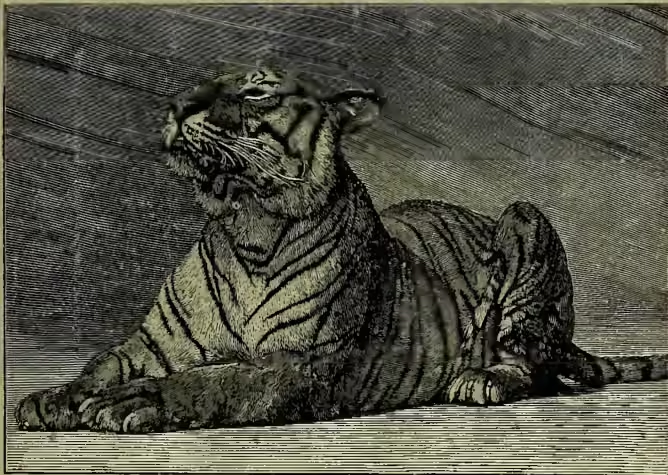
(From a Photograph by Gambier Bolton, F.Z.S.)
Asiatic, and has been found in almost all suitable localities south of a line drawn from the river Enphrates, passing along the southern shores of the Caspian and Sea of Aral by Lake Baikal to the Sea of Okhotsk. Its most northern range is the territory of the Amur, its most southern the islands of Sumatra, Java, and Bali. Westwards it reaches to Turkish Georgia, and eastwards to the island of Saghalien. It is absent, however, from the great elevated plateau of central Asia, nor does it inhabit Ceylon, Borneo, or the other islands of the Indo-Malayan Archipelago, except those above mentioned. The tiger may exceed the lion in length. Adult males measure to feet from the nose to the root of the tail, and the tail measures about 3 feet. The females are rather smaller. Blandford gives authentic instances of tigers over 10 feet long (with the tail), and weighing nearly 500 lb. The predominant colour is bright rufous fawn or tawny yellow, and is barred by dark or black cross stripes; the under parts are whitish. In details the dark markings vary considerably. The favourite haunts of the tiger are grassy plains and jungle swamps, where its colour often harmonises most deceptively with that of the surroundings. The animal takes readily to the water and swims well; it can also, if circumstances press it, climb trees. Like other Felidæ, the tiger is a solitary hunter and stalks its prey stealthily till within the fit distance for making a final spring. It feeds on cattle, deer, wild hogs, pea-fowl, &c., and some old 'man-eaters' haunt the neighbourhood of villages on the outlook for human prey. 'The man-eater,' Mr G. P. Sanderson says, 'is often an old tiger (more frequently a tigress), or an animal that, through having been wounded or otherwise hurt, has been unable to procure its usual food. It is as cowardly as it is cunning, fleeing before an armed man, between whom and a possible victim it discriminates with wonderful sagacity.' Young tigers are said to glut their taste for blood far beyond the limits of hunger, and the same is true of the mother while the young are still her companions. Sir Joseph Fayrer reports that a tiger will in ordinary circumstances destroy one or two cows or buffaloes a week, refraining from fresh attacks until it has consumed the results of one night's work. In attacking a large animal, such as a bullock, the tiger seizes the nape of the neck with its teeth, holds the victim firm with its sharp claws, and with a powerful wrench dislocates the vertebrae. From two to six cubs are born at once, and these the tigress guards, feeds, and trains with all maternal care. They remain with her until nearly full grown, or about the second year. It is said that the male tigers are eager to destroy young male cubs; and apart from this occasional cannibalism is recorded. In some parts of the East tigers are numerous enough to endanger human life very seriously; and tiger-hunting is in these conditions 'a most noble sport.' In 1882 the population of a village in the south-west of the Bantam province was removed and transferred to an island off the coast in consequence of the trouble caused to the people by tigers. Baker regards the tiger as a more formidable and ferocious beast than the lion. In spite of the government rewards, lack of enterprise and a superfluity of superstition still afford the tigers a wide range in India. In the three years ending 1889, for instance, 546 people were killed by tigers in Central India alone, besides 6882 head of 'cattle' ('including asses and pigs').
See FELIDÆ; also W. H. Flower and R. Lydekker, Study of Mammals (1891); Sir J. Fayrer, Royal Tiger of Bengal (1875); W. T. Blanford, Fauna of British India (1888); St George Mivart, The Cat (1881); Elliot, Monograph of the Felidæ (1878-83); Sir Samuel Baker, Wild Beasts and their Ways (1890). For so-called tiger-cats, see MARGAY, OCELOT, and SERVAL. The jaguar is the tigre of South America. Tiger-wolf is a name given to the spotted hyæna and to the Thylacine. 'Tiger-moth' is any of the Arctiidæ (whose larvæ are 'woolly bears'); and 'tiger-beetle' is a Cicindella (q.v.).