Tit, or TITMOUSE, a name given to several genera of Passerine birds in the family Paridae.
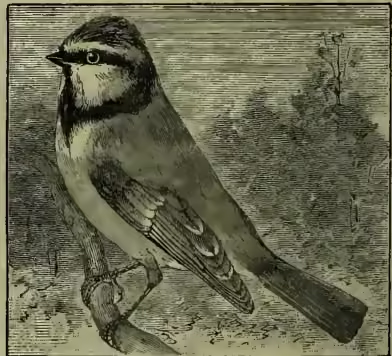
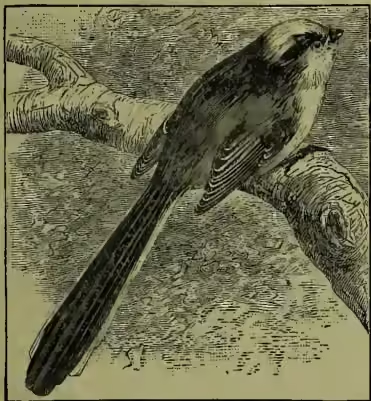
The typical tits are small birds, of which there are over sixty species, widely distributed throughout Europe, Asia, Africa, and North America. They are more numerous in cold and temperate than in tropical regions, those which are found within the tropics being mostly inhabitants of elevated mountainous districts. The bill is small, short, somewhat conical, the tip entire, the base beset with hairs, and the nostrils generally concealed by feathers. The wings are not very long; the tail is rounded or even; the legs rather short, slender, scaled in front, the inner toe shortest, the claws long and curved. The plumage is soft, lax, and fluffy, often gay. The popular name Titmouse is derived from Anglo-Saxon máse, a small bird (tit, 'small'). The tits are bold sprightly birds, extremely active, flitting from branch to branch, running rapidly along branches in quest of insects, and often clinging back-downwards to the under side of branches. They feed not only on insects but on grain and seeds, occasionally eat carrion, and sometimes kill young and sickly birds by strokes of their bill. They are very pugnacious, and the female tit shows great courage in defence of her nest, often continuing to sit when the nest is approached, and vigorously assaulting the intruding hand with her bill. In winter many of the species gather into small flocks, and approach houses and villages, competing with sparrows and chaffinches for a share of the food of domestic poultry. Most of the tits lay at least six eggs, some of them twelve or more, and even in temperate countries they often produce two broods in a year. They generally build in holes in trees, &c. The young are fed chiefly on caterpillars. A pair of blue tits have been observed to carry a caterpillar to their nest, on an average, every two minutes during the day, so that these birds must be extremely useful in preventing the multiplication of noxious insects. Six species are found in Britain, but one of them, the Crested Tit (Parus cristatus), is very local, being almost entirely confined to a few old pine-forests in Scotland. The Great Tit (P. major) is the largest European species. It is common in almost all parts of Europe. It is not quite six inches long; the head and throat are black; the cheeks are white; the breast and sides yellowish; the wings and tail grayish. Its usual note is a kind of chatter, but it sometimes imitates the notes of other birds. The Blue Tit (P. caeruleus) and the Cole Tit (P. ater) are very common in Britain. The blue tit is perhaps the most pert and audacious of all the British species. It very generally receives the familiar name of Tomtit. The upper part of the head is light blue, and a bluish tinge prevails in the plumage. The Long-tailed Tit (Acroculia caudata), common in Britain, has the tail about as long as the body. Its crown is white, contrasting beautifully with the deep black of the back; the tail is also black, with white edges. The nest of this bird is a beautiful structure, of moss and wool externally covered with lichens, and profusely lined with feathers, nearly oval, with a small hole in the upper part of one side. Still more interesting is the nest of the Penduline Tit (Aegithalus pendulinus) of the south of Europe, which in form resembles a flask, and is generally suspended at the end of a flexible twig, in a situation near to or over-hanging water. It is nicely woven of fibres of bark and the down of willow or poplar catkins, and the opening is in the side. The Chickadee or Black-cap Tit (P. atricapillus) is very common in North America. The Tufted Tit (P. bicolor) is the largest American species. British specimens of the Cole and Long-tailed Tits differ somewhat from continental examples, and are sometimes held to be specifically distinct. The so-called Bearded Tit (Panurus biarmicus) belongs to a distinct family (Panuridæ). It frequents reed and osier beds, and the male is tawny, with gray head and black moustaches, which ornaments are absent in the female. It is rare in England. See Howard Saunders, Illustrated Manual of British Birds (Lond. 1889); Gould, Birds of Great Britain, Birds of Asia.