Toad (Bufo), a genus of amphibians, typical of the family Bufonidae, represented in Britain by two species—the Common Toad (Bufo vulgaris) and the Natterjack (Bufo calamita). Toads are distinguished from frogs by the absence of teeth, by the roughness of the skin, by peculiarities in the breastbone, by the shorter hind-legs, and by the dilatation of the transverse processes of the sacral vertebra.
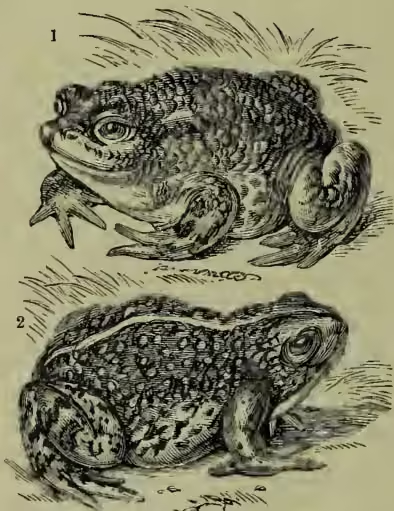
The common toad is a shy, nocturnal animal, hiding during the day in dark, damp places, crawling about at night in search of insects, grubs, slugs, worms, and the like. Its appearance is familiar—a dirty brownish-gray colour, a warty skin, a flat head, swollen parotid glands above the ears, bright jewel-like eyes with a transverse pupil, slightly webbed toes. They are heavier and clumsier than frogs, and cannot leap nearly so far. Hardy and tenacious of life, they often live for many (even forty) years, and can endure prolonged fastings. According to Buckland's experiments, a toad cannot live for two years without food and air; still, though tales of toads disintegrated from blocks of rock must be discredited, there is no doubt that they can survive for a long time in very disadvantageous conditions. During winter they liber- nate in the mud or in holes. In spring they pair, and the females lay in the water-pools their numerous ova in gelatinous strings 3 or 4 feet in length. The tadpoles are smaller and darker than those of frogs, and do not accomplish their transformation into terrestrial toads until autumn. Though toads cannot spit poison, the secretion of their skin glands contains a poisonous substance (phrynin), acrid enough to be felt on tongue or eyes, and probably conducive to the safety of the toads. Although regarded with disgust by the ignorant, the toad is an inoffensive and useful animal, and destroys injurious insects.
The Natterjacks or Rush Toads are rare in Britain, though Gilbert White found them more numerous than common toads in his garden. 'It is of a light yellowish-brown colour, clouded with a dull olive, and there is a bright yellow line running down the back. It is found in dry situations. It is less timid than the common toad, and its eyes are more prominent, its warts larger, its tadpoles smaller, their metamorphoses much shorter.' It has a strong repulsive smell. The gait is more like walking or running than the crawling of the common toad.
The genus Bufo includes over seventy species. These are widely distributed over most parts of the continents, but are most abundant in tropical regions. The largest, B. marinus of tropical America, measures 8 inches in length. Some, e.g. B. typhonius, have bony ridges on the head; some, e.g. B. compactilis of Mexico, have a shovel-like hand modified for digging. A really venomous toad is found in the Argentine Republic (see Hudson's Naturalist in La Plata, 1892). Among the other genera may be noted the burrowing Rhinophrynus of Mexico, the Australian Pseudophryne, the Cuban Peltaphryne, the Central American Cranopsis, which differ considerably as regards the degree of ossification in the skull. Among the amphibians which are more nearly related to toads than to frogs are the Horned Toad (Ceratophrys), the Tree-frogs (q.v.; Hylidae), the Fire-bellied Toad (Bombinator igneus) common in Germany, and the 'midwife toad' (Alytes obstetricans) of western Europe. See AMPHIBIA, FROG.