Tomb (Gr. tymbos), a monument erected over a grave, in order to mark the resting-place, and preserve the memory, of the deceased. In early ages, and among eastern nations, it sometimes became the practice to place the remains of the dead in excavated sepulchres, whose interior was often decorated with painting or otherwise. Where the usage was to burn the dead their bones and ashes were placed in urns in these receptacles. Some of the most remarkable rock-tombs were those of Egypt. The rock-tombs of Persia and Lycia have imposing architectural façades. See also CATACOMBS, ETRURIA, PETRA.
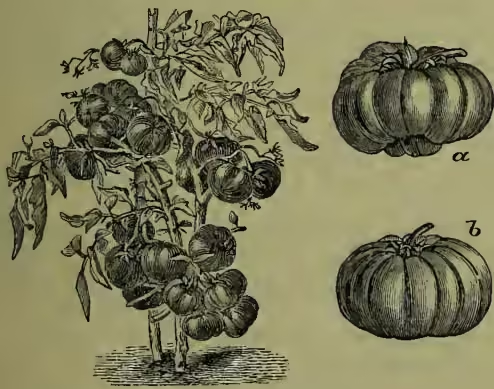
a, fruit of do.; b, fruit of common tomato.
Tombs in more modern times have generally been mounds or masses of building raised over the remains of the dead. In the Homeric poems heaps or cairns of stones are placed as honorary memorials above the graves of departed heroes. The tumulus of rude ages (see BARROW, CAIRN) is found over the greater part of northern Europe, and is probably older than the subterranean tomb. The Pyramids (q.v.) were the sepulchres of the Egyptian monarchs from the 4th to the 12th dynasty. The tombs of Greece, and still more those of the Greek colonies in Asia Minor, were sometimes pillars, or upright stone tablets, sometimes small buildings in the form of temples; the most celebrated was the Mausoleum (q.v.). The Roman tombs were not unfrequently important architectural structures, varying in form, but oftenest consisting of a circular tower resting on a square basement; familiar examples being the tomb of Cæcilia Metella (see ROMAN ARCHITECTURE), and the yet larger and more solid tomb of Hadrian, on the banks of the Tiber, best known as the castle of S. Angelo, which is about 220 feet in height, and of immense solidity. The tombs were generally erected outside the towns, and along the principal roads leading into the country, as in the Via Appia at Rome, and the Street of Tombs at Pompeii. A form of excavated tomb, without external architec- properties of many of the species comprised in it, it is now recognised as one of the most important and valuable of vegetables grown for human food. Though it was introduced into Britain as early as 1596, the consumption of its fruit there is still small as compared with some other European countries and America, but it has increased immensely since 1880. The annual supply produced in Britain is quite inadequate to meet the demand, which is yearly increasing as the agreeable qualities of the fruit become more widely known; consequently enormous quantities of it are imported, packed dry and in tins, the latter being chiefly used in making soups and sauces. The imported fruit, having to be packed in an imperfectly ripe state in order to reach its destination in safety, is inferior to that grown in Britain in colour, flavour, and texture; the latter, therefore, commands the highest price in the market. On this account the culture of the tomato has of ture, called Columbarium (q.v.), was also in use in Rome, whose walls were pierced with cells to receive cinerary urns. The prevalent circular tomb became in the later period of the Roman empire polygonal. In many parts of Italy, and in such Spanish-American towns as Lima and Quito, the cemeteries contain rows of niches rising above one another in terraces, honeycomb-like, and each holding a coffin, which rests there so long as the heirs pay the rent.
In the earlier centuries of Christianity the burial of the dead in churches was prohibited. The first step which led to its adoption was the custom of erecting churches over the graves of martyrs; then followed the permission to kings and emperors to be buried in the church porch. The most important tombs of the middle ages are generally within churches or cloisters. The earlier examples consist of a simple stone coffin, or sarcophagus, often with a low gabled lid and a sculptured cross. An altar-tomb, or tomb in the form of a table, followed; and in the 13th century a species of tomb was introduced, consisting of a sarcophagus, on which rests a recumbent figure of the deceased, the whole being surmounted by a canopy, often of exquisite symmetry and richness (see illustration at CANOPY). The tombs of the Scaligers at Verona, with their beautiful wrought-iron railing, are famous. In the renaissance period of art the tombs became more and more complex. The sarcophagus was disguised, or made the least important part of the monument; the representation of the deceased was confined to a medallion likeness, and the most prominent part of the tomb was composed of sculptured upholstery, and groups of symbolical and eventually mythological figures. In some of the 16th-century examples, as Michaelangelo's tombs of Giuliano and Lorenzo di Medici, at Florence, the inappropriateness of the design is partly redeemed by the beauty of the figures; but in the succeeding centuries the vicious taste of these monuments rapidly increased, till it culminated in some of the hideous tombs that disfigure Westminster Abbey and St Paul's. See also the articles BURIAL, CEMETERY, NECROPOLIS, and others cited at MONUMENTS.