Tongue, a symmetrical, muscular organ, extending from the hyoid bone upwards and forwards to the lips in front, and occupying the buccal cavity. The superior surface, borders, and anterior third of the inferior surface are free; elsewhere it is attached to adjacent parts by the investing mucous membrane and subjacent structures. At certain points this membrane forms distinct folds, containing fibrous or muscular tissue, which act to a certain extent as ligaments to the tongue. The most considerable of these folds is termed the frænnum (or bridle) of the tongue, and connects its anterior free extremity with the lower jaw. It acts as a strong ligament, and limits the backward movement of the tip of the tongue. In very rare cases this ligament extends abnormally to the tip, so as to interfere with speech and mastication, and the child is said to be 'tongue-tied'; recourse must be then had to division of the frænnum, popularly known as 'cutting the tongue.' Other folds of mucous membrane pass from the base of the tongue to the epiglottis; while from the sides of the base, passing to the soft palate, are seen two folds on either side, the 'pillars of the fauces' (see PALATE). The superior surface of the tongue is divided into two symmetrical lateral parts by a median longitudinal furrow, commencing at the tip, and extending back about two-thirds of the tongue's length. The various kinds of papillæ on their surface are described in the article TASTE. At the back of the surface, just behind the circumvallate papillæ, are large mucous glands, extending into long and capacious canals, and helping to secrete the fluid that moistens the tongue. On the inferior surface the longitudinal furrow, which extends from the tip to the frænnum, is deeper than on the upper surface; on each side of it veins are seen running forwards; and immediately beneath the tip is a cluster of mucous glands, known as the glands of Nuck (their discoverer in 1690). The posterior extremity, or base, is flattened and extended laterally before it is inserted into the hyoid bone (known also as the lingual or tongue bone), which, with certain ligaments, must be regarded as the basis or framework of the tongue. The muscles of the tongue are usually divided into two groups—viz. the extrinsic muscles, which attach the tongue to certain fixed points external to it, and move it on them; and the intrinsic muscles, which pass from one part of the tongue to another, constitute its chief bulk, and move it on itself. These intrinsic muscular fibres run vertically, transversely, and longitudinally, and are so interlaced as mutually to support one another, and to act with the greatest advantage. By the action of the various muscles, the upper surface of the tongue may be made concave or convex, or may be pressed against the roof of the mouth; the tip may be protruded straight out or laterally, upwards and downwards, and into any recess. The organ is freely supplied with blood, mainly by the lingual artery, which is given off by the external carotid. With regard to the nerves, the glosso-pharyngeal and certain branches of the third division of the fifth nerve are concerned in the special sense of taste; other branches of the fifth nerve are concerned in ordinary sensation, while the hypoglossal nerve on each side is the motor nerve of the tongue.
The tongue in mammals does not differ very materially from that of man; but in general there is a close coincidence both in size and form between this organ and the lower jaw. In the rodents the tongue has a wedge-like shape. In the giraffe and the ant-eater the tongue is much prolonged, being an important prehensile organ in the former, while in the latter it is driven into ant-hills, and the victims are secured by its viscid secretion. In the feline races the conical papillæ are converted into recurved spines of great size and strength, which the animal uses in scraping bones and in combing its fur. Except in mammals, the tongue is probably not an organ of taste. The Gasteropoda are provided with a very singular apparatus known as the tongue, and consisting generally of a thin membrane, long and narrow, and rolled, except at its anterior extremity, into a tube; this membrane is covered on its upper surface with transverse rows of minute teeth, or more commonly with plates having tooth-like siliceous projections. The Articulata do not present anything like a true tongue, although in insects a certain oval appendage is described as a lingua.
The functions of the tongue are gustation, prehension (in man and monkeys this function is supplied by the hand), mastication, insalivation, deglutition, and speech; to which may be added spitting and whistling, and in the case of the Gasteropoda the trituration of the food.
In its medical relations the tongue is of great importance as an index to the condition of the system, and particularly of the digestive organs; its appearance, whether firm or flabby, moist or dry, clean, furred, or unduly red and bare, is a valuable guide both as to the diagnosis and treatment of disease.
Amongst the diseases of the tongue may be mentioned Inflammation or Glossitis. The most marked characteristics of this affection are great swelling, tenderness, and difficulty in speaking and swallowing. It rarely occurs as an idiopathic or spontaneous affection, but often used to accompany severe salivation. It must be treated by purgatives and low diet, and by gargling, as in ordinary salivation (see SALIVA). Incisions are sometimes useful, both to relieve tension, and by the depletion that ensues. Abscess in the tongue is also occasionally met with.
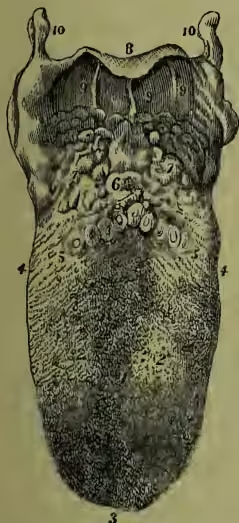
1, mesial line; 2, 2, lateral parts; 3, tip; 4, 4, sides or edges; 5, 5, V-shaped mass of circumvallate papillæ; 6, foramen caecum; 7, mucous glands; 8, epiglottis; 9, 9, 9, fræna epiglottidis; 10, 10, greater horns of hyoid bone.
(From Scemmering.)
Hypertrophy, or persistent enlargement of the tongue, sometimes seems to result from an imperfectly cured inflammation, but is probably in most cases congenital, although perhaps not noticed for a year or two. It sometimes attains an enormous size, but can generally be relieved by operation, at least in its earlier stages. A good deal of attention has been given during recent years to a condition called leucoplakia, consisting in whitish spots or patches on the surface of the tongue, very chronic in their course, often traceable to some irritation, particularly smoking, and especially important because they not infrequently become the seat of cancer. One of the most common forms of disease of the tongue is ulceration, which may arise (1) from the irritation of a decayed tooth with a sharp jagged edge; or (2) from constitutional syphilis; or (3) from a disordered condition of the digestive organs. In the first case the tooth or its edge must be removed; in the second iodide of potassium with sarsaparilla should be tried; and in the third the complaint generally yields to regulation of the diet and of the digestive organs. Cancer is by far the most common tumour met with in the tongue, and is nearly always of the epithelial variety. It is frequently connected with some cause of irritation—e.g. from a broken tooth, or from excessive smoking—and is very much more common in men than in women. It is in general a rapidly fatal form of cancer; and operations for its removal, always serious, are less often followed by immunity than in some other organs. See Butlin, Diseases of the Tongue (1885).