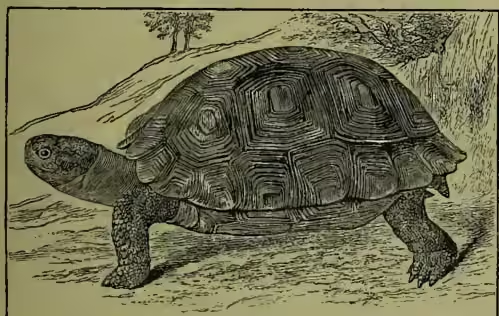
Tortoises and Turtles (Chelonia) form a well-defined order of Reptiles, distinguished especially by the dorsal and ventral shields which protect the body. Although terrestrial Chelonians are often called tortoises, and aquatic Chelonians turtles, the distinction cannot be sustained. The dorsal shield or carapace, within shelter of which the head, limbs, and tail can be more or less completely sheltered, is formed (a) along the middle line by the vertebrae whose neural spines are flattened, (b) by expansions of the parts which in other animals form well-defined ribs, and (c) along the edge by marginal plates ossified in the under skin or dermis. The dorsal vertebrae and ribs are thus rigidly involved in the carapace; the neck and the tail are the only flexible parts. The ventral shield or plastron consists of nine bony pieces, one anterior and four on each side. They arise as membrane bones in the dermis. Overlapping, but not corresponding to the bones of the shields, are horny epidermic plates of 'tortoise-shell,' which although hard are not without sensitiveness, numerous nerves ending upon them. The bones of the skull are immovably united together; there are no teeth, although in an embryonic turtle (Trionyx) traces of them have been detected. The limbs are very typical, and the girdles, which are over-arched by the ribs in the course of development, are well developed. There is no breastbone, and, according to most authorities, there are no clavicles. The brain of the adult Chelonian shows a slight curvature, and, as in all higher vertebrates except snakes, there are twelve cranial nerves, two more than occur in amphibians and fishes. The heart, as in other reptiles except crocodiles, is anatomically three-chambered, but the presence of an incomplete partition in the ventricle makes it work almost as if it had four chambers. The food-canal, ureters, and genital ducts open into a common cloaca, to the wall of which in the males a penis is attached. The large lungs are fixed along the dorsal wall of the thorax. As the body is boxed in by shields which are often quite rigid, the contraction and expansion of the lungs in respiration must be due partly to their own elasticity, partly to the movements of the viscera with which they are closely connected, and partly to the changes which result when the animal retracts or extends its head and limbs. At the best the respiration is sluggish; and, as this will affect the whole pitch of the animal's life, the sluggishness may be regarded as the price paid for the very strong armature.
Tortoises excel most animals in their tenacity of life. They can live for a long time without food; they are very difficult to kill, and even after the brain has been destroyed life lingers long in the body. It is said that a headless tortoise has been observed to walk 200 yards twenty-four hours after decapitation; and it is well known that the heart removed from the body will, if carefully suspended in a moist chamber, continue capable of beating for two or three days. All Chelonians are oviparous. The eggs have a firm shell, which is in most cases rigidly calcareous. They are usually laid in the sand or mud, and left to be hatched by the warmth of the sun.
There are two sub-orders of Chelonians—(a) Athecata, in which the carapace is flexible; and (b) Testudinata, in which it is rigid. The Athecata are represented by one living species, the Trunk-back or Leather Turtle (Sphargis coriacea), the largest modern Chelonian, sometimes measuring six feet in length, and sometimes weighing over a thousand pounds. It is widely but very sparsely distributed in tropical and temperate seas—in the Atlantic, Pacific, and Indian oceans, and in the Mediterranean. It is said to be herbivorous.
The Testudinata include four families—Chelonidae, Testudinidae, Chelydidae, and Trionychidae. The Chelonidae are strong marine turtles, with flipper-like feet, and broad, partially ossified shields. A well-known representative is the Green Turtle (Chelone mydas or viridis), which occurs along the
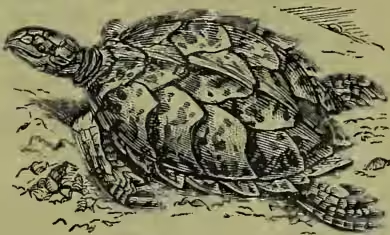
Atlantic coast from southern Brazil to Cape Hatteras. It feeds on the roots of the sea-grass (Zostera), and attains a very large size (sometimes weighing 850 pounds), and is the most important of the edible turtles. Both the flesh and the eggs are much esteemed. Notable, also, is the Hawk's-bill Turtle (Caretta or Eretmochelys imbricata), a ferocious carnivorous form occurring along the coasts of the United States, and supplying most of the commercial 'tortoise-shell.' The flesh is slightly esteemed, but the eggs are palatable. The same is true of the Loggerhead (Thalassochelys caouana or Caouana caretta), a large Atlantic turtle, also carnivorous in habit. The Testudinidae are terrestrial Chelonians, such as the Greek Tortoise (Testudo graeca) often brought from Mediterranean countries to Britain, where it usually leads a miserable existence as a pet. Notable are the gigantic forms (Testudo elephantopus, &c.), which were once abundant in the Galapagos Islands and in some islands of the Indian Ocean, but are now in process of rapid extermination. The Chelydidae are Chelonians with long necks which are not retractile within the carapace. The strangest of these is the bearded Turtle (Chelys matamata), a carnivorous form once abundant in fresh-water pools in tropical South America. The Trionychidae or soft-shelled turtles, are fresh-water forms with depressed bodies, covered with soft skin, and webbed yet partly clawed feet. A typical representative is Aspidonectes ferox, which lives in the rivers flowing into the Gulf of Mexico, and is famous for its activity, voracity, and fierceness. They usually measure rather over a foot in length. Their flesh is very palatable. See also TERRAPIN.
According to another classification, the Testudinata are divisible into two groups, distinguished by the manner in which the head is retracted. In one set—the Cryptodirans, or hidden-necked Chelonians—'the head is drawn directly within the margin of the shell by the bending of the neck in an S-like manner in a vertical plane.' In the other—the Pleurodirans, or side-necked Chelonians—'the neck is bent sideways, so that the head, when retracted, lies on one side of the front aperture of the shell near one of the legs.'
TORTOISE-SHELL, the large scales of the carapace or shield of a species of sea-turtle, the Caretta imbricata (see above). Tortoise-shell is so called because formerly the order of animals to which it belongs was little known, and all were confounded under the general name of Tortoises. A remarkable peculiarity in this species is the arrangement of the thirteen plates forming the carapace, which, instead of being joined together by their edges so as to make apparently one piece, are thinned off at their edges, and overlap each other like the tiles of a roof. They vary in size according to the part of the shield they occupy. The larger are sometimes from a foot to 18 inches long, by 6 inches broad; the thickness rarely exceeds the eighth of an inch. The beautiful mottled colour and semi-transparent characters of this material are well known. A remarkable quality is possessed by tortoise-shell which very greatly increases its usefulness for the ornamental purposes to which it is generally applied—i.e. the property of being easily softened by a heat equal to boiling water, and of retaining any form when cold which has been given to it when heated. Pieces can also be welded together by the pressure of hot irons properly applied. In Britain the chief use of tortoise-shell is making combs for the hair; but it is also used for inlaying ornamental furniture and various other fancy objects. By the French cabinet-maker Boule (see BUHL) it was used most effectively in combination with brass as a veneer for rich furniture, and all boule or ‘buhl’ work consists of such a veneering combination. In India, China, and Japan many articles are made of it, showing great skill and taste.