Toucans (Rhamphastidae), a family of Zygodactyle Picarian birds, numbering more than fifty species, and inhabiting tropical America. They were formerly placed near the Hornbills (Bucerotidae), which offer several points of analogical resemblance to them, and are often improperly called toucans in the East; but their nearest allies are now known to be the Barbets (Capitoniidae), one of which, Tetragonops rhamphastinus, strongly resembles a toucan in its coloration, &c.
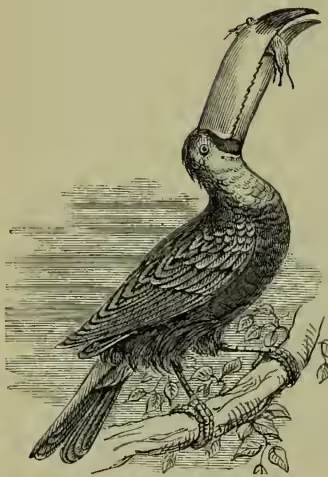
The toucans are divided into five genera: Rhamphastos, containing the typical species, has the bill most greatly developed, and the plumage mostly black, varied with white, scarlet, and orange; Andigena, containing the Hill Toucans, inhabiting the high forests of the Andes, and with a generally bluish-gray plumage; Pteroglossus, with smaller, long-tailed species, clothed in green, scarlet, and yellow plumage, and called Araçaris; Selenidera includes the Toucauets, which are very similar; the species of the last genus, Aulacorhamphus, are of a bright green colour. The legs of the toucan are strong, rather short, and with large scales; the toes are arranged in pairs, the first and fourth being turned backward. The form of the body is short and thick; the tail is rounded or even, varying in length in the different species from half the length to almost the whole length of the body, and is capable of being turned up over the body in a remarkable manner, which it always is when the bird is at roost. The neck is short and thick; the enormous bill is at the base of the full width and depth of the head, and is in some species more than half the length of the body. It is arched towards the tip, irregularly toothed along the margins of the mandibles, and extremely cellular and light, yet strong in structure. The tongue is very long, narrow, and singularly feathered on each side, the processes which give it this feathered appearance possibly adding to its sensibility as an organ of taste. When a toucan takes food between the points of the mandibles, the tongue is immediately applied to it, as if to test or enjoy it, and afterwards it is tossed into the throat by a sudden throwing back of the head. Toucans may almost be described as omnivorous; they eat fruits with avidity, but they also seize and devour small birds. Their powerful bill enables them to kill a small bird by a single squeeze. They make a curious clattering noise with their great mandibles, and also emit at times a harsh cry, sometimes resembling the word tucano, whence their name. They live chiefly in the depths of the South American forests, in small flocks, and lay two white eggs in the holes of trees. They are easily tamed, and bear cold climates well. In captivity they readily eat rice, bread, potatoes, eggs, and many other kinds of food. They are remarkable amongst birds for regurgitation of food, in order to a kind of mastication in the great bill, analogous to rumination in quadrupeds. The colours of the bill are, in most of the species, very brilliant during life, but disappear from stuffed specimens in museums. The largest species, as Rhamphastos Toco, are about two feet in length; the R. Arict is the commonest species. See Gould's Monograph (2d ed. Lond. 1854).