Touraco (Opisthocomus cristatus), called also Hoatzin, Cigana, Gypsy, and several other names, a bird about the size of a pheasant, found in
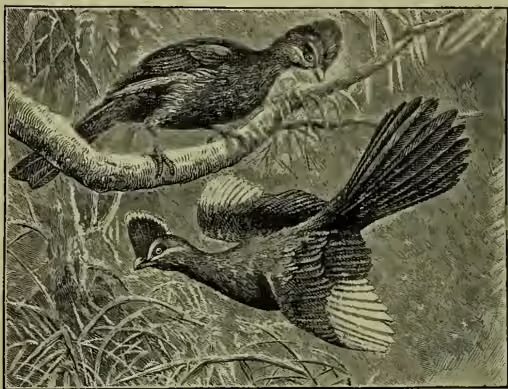
Guiana and the Amazon region, and constituting the family Opisthocomidae and order Opisthocomi. Wallace remarks that it has 'such anomalies of structure that it is impossible to class it along with any other family. It is one of those survivors which tell us of extinct groups, of whose past existence we should otherwise, perhaps, remain for ever ignorant.' The most striking anomalies are the sternal apparatus, the divided muscular crop, and the reptilian character of the head of the unhatched chick. It lives in flocks on the lower trees and bushes bordering streams and lagoons, and feeds on various wild fruits, is never seen on the ground, and is nowhere domesticated. Its flesh is uneatable owing to its unpleasant odour.
See Bates, The Naturalist on the Amazons; Huxley, Proceedings of the Zoological Society (1868); Garrod, Proceedings of the Zoological Society (1879); Quelch, In the Ibis (1890). The name is also given to some of the quite different Plantain-eaters (q.v.) of Africa.