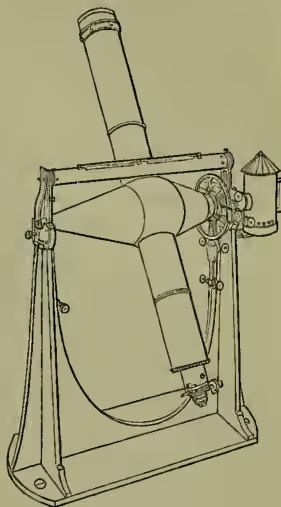
Transit-instrument, one of the most important of astronomical instruments, consists of a telescope fixed to a horizontal axis, so as to revolve in the plane of the meridian. It is employed, as its name denotes, in the observation of the meridian transits of the heavenly bodies—i.e. the apparent passage of the heavenly bodies across the observer's meridian, an appearance due to the revolution of the earth (for the transits of Venus, see SUN, Vol. IX. p. 803). The axis, which is the most important part of the instrument, and thus demands the utmost care in its construction, consists of a hollow sphere or cube, to opposite sides of which are tightly fastened the bases of two cones in whose apices the pivots are screwed; the sphere or cube is pierced for the admission of the telescope, which is firmly soldered at right angles to the axis. One of the pivots is hollowed so that a stream of light can be directed from a lantern, through an aperture in the side, and half-way along the interior of the axis, into the telescope tube, where, being received by an annular mirror set at 45° to the axis and telescope tube, it is directed to the eyepiece, and brilliantly illuminates the field of view, while the annular form of the mirror prevents any interference with the passage of rays from the object under observation to the eye. The pivots must be very carefully turned to a perfectly cylindrical form, and fitted into the instrument, so that their axes are accurately in line. One extremity of the axis carries one and sometimes two small graduated circles, each supplied with index, clamping screws, and vernier; these circles are capable of indicating angular measures to within 1' or 2'. The pivots rest on massive blocks of stone or other stable material which is little affected by change of temperature, stability being the great mechanical essential of the instrument. This condition satisfied, there are three adjustments necessary before a transit can be observed: the axis must be horizontal; the line of collimation must be at right angles to the axis of motion; and the latter must be placed so as to point accurately east and west. On the perfection of the first two of these adjustments depends whether the telescope sweeps over a great circle of the sphere, and the third is necessary to ensure that this great circle shall be the meridian of the place of observation. These adjustments can never be made quite perfect, and the usual mode is to investigate the amount of error in each, and allow for it in the apparent result. To note accurately the instant of time by the astronomical clock at which the object (e.g. a star) is seen to pass the centre of the field of view is the essential part of a transit observation. The most effective method is to register the beats of the clock by an apparatus which at the end of each oscillation of the pendulum marks a dot upon a uniformly moving slip of paper. This is effected by the agency of electricity, and is one of its most valuable contributions to astronomical science. At a certain point in each oscillation of the pendulum it becomes part of a complete galvanic circuit, the contact being immediately broken by its progression in its oscillation; and it is at these points that the galvanic agency causes the dot to be made. The instant of a transit's occurrence is similarly noted by the observer, who, by a tap on a break-circuit key, fastened to the side of the transit-instrument, causes the graver to make an extra dot; and the distance of this dot from the previous seconds one, compared with the distance between two seconds dots, gives the time accurately almost to of a second. Various ingenious modes of registering have been proposed, all founded on the above principles. It is from the times of transit of the several heavenly bodies thus accurately observed that their right ascensions are determined.
The transit-instrument was invented by Römer about 1690. One was erected in Greenwich Observatory by Halley in 1721; but it was little used till 1742. The transit-instrument there now is by Troughton, and was erected in 1816.
The transit-circle differs mainly from the older transit-instrument in the addition, on the axis of rotation, of two large graduated circles which are read off by microscopes fixed on an independent coaxial wheel called an alidade, any variation in the position of which may be detected by a large spirit-level attached to it. This instrument is as well suited for giving the declinations as for giving transits or right ascensions.