Transplanting, the act of removing bodily a plant or tree from the place in which it grows, and establishing it in the same or another place. The operation is in continual practice in gardens and nurseries throughout the year, and it is of immense practical utility. But for the facility with which the great majority of cultivated plants may be transplanted, gardens would be comparatively profitless and uninteresting, and pleasure-grounds and the landscape be adorned only with indigenous forms of trees, shrubs, and flowers. In the large trade nurseries transplanting is one of the chief occupations of the workers. Seedling forest trees are reared annually in hundreds of thousands, and either are transplanted in the nursery to adapt them for special purposes, or are transferred from the seed-bed at the age of one or two years direct to moors and hillsides to form woodlands. Ornamental shrubs from all temperate countries are in the same way prepared for distribution. Fruit trees are especially benefited by the process. By frequent transplantings fruitfulness is accelerated in young fruit trees, and the operation is systematically resorted to in order to maintain fertility in those that are more aged.
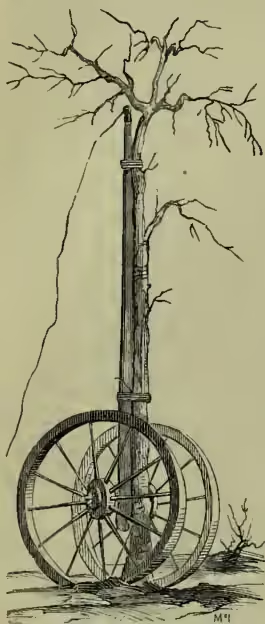
The operation is most practicable in the youthful stage of all plants. In those that are aged and have been long established in one place it is attended with danger, chiefly because in the case of large trees and shrubs it is impracticable to preserve uninjured a sufficiency of the fibrous roots to draw nourishment from the soil. Yet very large trees have been successfully transplanted. At Chatsworth, Dropmore, and many other places trees exceeding 50 tons weight have been transplanted from one situation to another several miles distant. Such herculean operations in transplanting, while quite practicable, are attended with an amount of expense and hazard which precludes their being generally engaged in. Yet at the places named, and others equally notable, sylvan effects have been created in bleak, treeless situations in two or three years by this means, which would have taken half a century to produce in the ordinary course. In moving trees of a size exceeding that which two or three men may easily handle, trans- planting machines are required. These are of various kinds, and each has special merits not possessed by others. The best machines for the removal of very large trees from one place to another are Barron's and M'Glashan's. These two inventions have some features in common; they are ponderous four-wheeled carriages in which the tree is swung in chains or on a platform upright as it grew, and may be carried any distance where bridges overhead do not occur in the way. M'Nab's apparatus (see figure) is the best for lifting trees and shrubs of considerable size, but is incapable of the ponderous work of either of the other machines, and it has the further disadvantage that the tree must be carried in a horizontal position. The transplanting of large trees successfully involves the possession of considerable experience of the work by the person superintending it. He should know the proper time or season for the transplanting of each kind of tree with which he has to deal. Various kinds of trees are not all amenable to the same methods. Greater care is required in every stage of the work with some than with others. The prime object to keep in view in every case is the preservation of the fibrous roots; every one of these destroyed lessens the chances of success. When it is determined to transplant trees which have been growing undisturbed for some years, it is necessary to prepare them one or two years prior to lifting them. A trench is opened in a circle 2, 3, or more feet—according to the age and size of the tree—from the bole all round, and all the roots are cut off beyond the circle. The trench is carried deep enough to reach all the roots, and is then filled up either with the earth excavated or, in cases requiring special care, with soil of a kind more favourable to the formation of fibrous roots. The mutilated roots send out new feeders into the new soil, and if the work has been properly done they will be numerous enough one or two years hence, according to the peculiarities of the subject, to bind the new soil in a compact mass, and thus facilitate the transportation of a considerable ball of earth along with the tree.
Limes, poplars, willows, and such-like quick-growing and free-rooting trees are more easily transplanted when of considerable age than oak, beech, sycamore, and the like. Evergreen trees and shrubs transplant most successfully in spring, when they are beginning to grow. Deciduous subjects on the other hand succeed best when transplanted immediately after the fall of the leaf. Surrounding the roots with light compost and watering, and mulching the area over which the roots extend to lessen evaporation, are ordinary but essential means to success, especially in the case of large and difficult subjects. Securing the tree at once against disturbance by wind after it is planted is of vital importance.—For the transplanting of skin, see SKIN, RHINOPLASTIC OPERATIONS; and of teeth, see DENTISTRY.