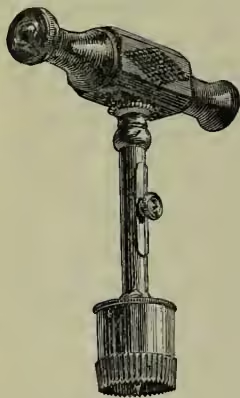
Trephine. The instrument in its original form was like a carpenter's brace, and was called a trepan, from Gr. trupaō, allied to Lat. tereō, 'I bore.' The operation of trephining consists in the perforation of a bone, usually the skull, by means of a trephine, which is a small cylindrical or circular saw, with a centre-pin on which it works. It is practised on the skull in cases of fracture, chiefly when symptoms of compression or irritation of the brain are produced by depressed portions of bone, or by hæmorrhage beneath the skull; as a necessary preliminary to all operations on the brain—e.g. the evacuation of abscesses; for the removal of the focus of irritation in certain cases of epilepsy, &c., particularly where the disease has followed injury to the head; and even in rare cases for the removal of tumours. Trephining was known and practised in prehistoric times; some sixty skulls of the Stone Age that had been thus practised on are to be found in French archaeological museums. Comparatively recently it was used almost as a routine treatment in severe head injuries; but it is now restricted to a very small proportion of such cases. The advance of knowledge of localisation of function in the brain, and the introduction of antiseptic methods in surgery have, however, extended its scope in other directions. It has recently been applied to the treatment of certain forms of idiocy and insanity, and in some cases with apparent benefit, at any rate for a time.