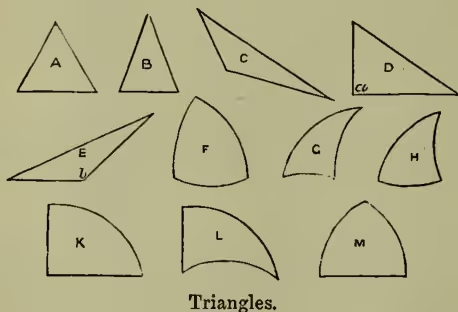
Triangle (tres, 'three,' angulus, 'a corner'), the most simple of closed geometrical figures, is a figure having three angles, and consequently three sides. It is, indeed, generally defined by geometers as a figure of three sides, and its property of being three-angled is put in the subordinate position of a necessary consequence. In plane geometry a triangle is bounded by three straight lines; and triangles are classed according to the relative length of their sides into equilateral (A), or equal-sided; isosceles (B), or having two sides equal; and scalene (C), or unequal-sided. Considered with reference to the size of its angles, a triangle is right-angled (D) when one of its angles () is a right angle (), obtuse-angled (E) when it has one angle () greater than a right angle, and acute-angled (A or B) when it has no angle so great as a right angle. The triangle being the fundamental figure of plane geometry, through which the properties of all other figures have been arrived at, the investigation of its properties has always been held to be of primary importance. The simpler of these properties have of course long been known; but in modern times a whole system of geometry has grown up known as the geometry of the triangle, in which an endless number of remarkable properties are discussed. To the modern geometer the triangle connotes not merely the closed figure bounded by the sides, but the outside regions of space marked off by the sides produced to infinity. Of special importance also are those lines drawn through the angles which bisect these angles, or bisect or are perpendicular to the opposite sides. Then there are many interesting theorems connected with the inscribed, circumscribed, and escribed circles (see Casey's Sequel to the First Six Books of Euclid). The area of a triangle is half of that of a parallelogram which has the same base and altitude, and is thus equal to half the product of the base into the altitude. In the geometry of the sphere a triangle is a figure bounded by three arcs of circles (as F, G, H, K, L, and M). For triangulation, see ORD-NANCE SURVEY, SURVEYING, TRIGONOMETRY; for triangular numbers, see FIGURATE NUMBERS.