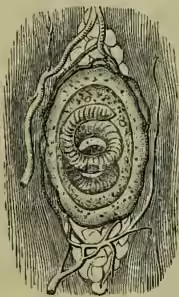
Trichina (Trichina spiralis), a minute parasitic Nematode, occurring in man, pig, rat, and also in hedgehog, fox, marten, dog, cat, rabbit, ox, and horse. The sexual forms are found in the intestine—the female nearly of an inch in length, the male about half as long. After impregnation the female brings forth numerous embryos viviparously, sixty to eighty at a time, and altogether about 1500, which bore through the wall of the intestine into the body-cavity or blood-vessels, and work their way, especially through connective tissue, to the muscle fibres, within which they grow, coil themselves spirally, and become encysted with a sheath at first membranous and afterwards calcareous. In these cysts, which may be sometimes present in millions, the young Trichinae remain passive unless the flesh of their host be eaten by another—as by a pig eating a rat, and a man eating the pig. In the alimentary canal of the new host the capsule is dissolved, the embryos are set free, and rapidly developing become reproductive and migratory. The migrations of the young forms from the food canal to other parts of the body of the host produce disorders which are often fatal.
TRICHINIASIS, or TRICHINOSIS, is the name of the diseased condition which is induced by the ingestion of food containing Trichina spiralis in large quantity. It was first recognised as a distinct disease by Zenker in 1860; since that time a few cases have been met with in England, many in the United States, but most in Germany (largely on account of the common custom of eating smoked ham and uncooked), where epidemics have been not infrequent. For about a week the symptoms are those merely of the feverish state; but about that time the muscles begin to be painful and tender to the touch, and are found to be hard and swollen. Movements of the affected muscles are painful or even impossible; so that the limbs and jaws may be fixed, and the breathing may become hurried and shallow. In severe cases diarrhoea often occurs. When death takes place it is usually in the fourth or fifth week, either from exhaustion, intestinal irritation, or pneumonia. In some epidemics one-fourth or one-fifth of the cases are said to have proved fatal. Convalescence is usually very slow; three or four months may elapse before the health is restored. No means is known of destroying the parasites when they have reached the muscles; but when the disease is suspected castor-oil or calomel should be administered to expel as many of the embryos as possible from the intestines. Glycerine is said to be fatal to them, and to have been administered with benefit. But even infected meat is rendered innocuous by thorough cooking.