Trogons (Trogonidæ), a family of birds of the order Picariæ, not very closely allied to any other group. They have the bill short, broad, notched or serrated, and with a wide gape; the feet small and weak, with the toes in pairs; but the first and second toes are turned backward, instead of the first and fourth—an arrangement unique among birds. The wings are short and somewhat pointed; and the tail is long and broad, often overhung by long tail-coverts. The plumage is soft, lax, and loosely attached to the very delicate skin; it is very beautifully coloured, some species being only excelled in brilliancy by the humming-birds. The females are less gorgeous than the males. The trogons inhabit the tropics of the old and new worlds; they are most numerous in South America, less so in the oriental region, and are represented in Africa by two species only. They are birds of moderate size, and sedentary and unsocial habits, inhabiting forests, where they sit motionless on branches, occasionally darting off to seize fruits or insects. They nestle in holes in decayed trees, laying two to four eggs, white or pale in colour. There are about fifty species, of which the most celebrated is the Quetzal, or Resplendent Trogon
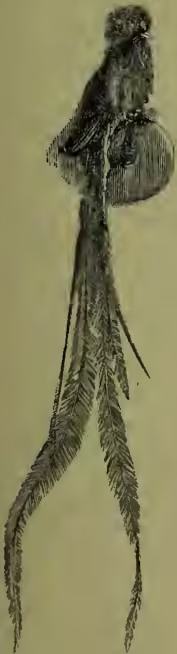
(Pharomacrus mocinno or Calurus resplendens), whose plumage is of a magnificent golden green, the centre tail-coverts of the male being nearly three feet long, though the bird is only of the size of a magpie. It inhabits Central America: Guatemala especially is the 'Land of the Quetzal.' See Gould's Monograph of the Trogonidæ (2d ed. 1875), and Brigham's Guatemala (1887).