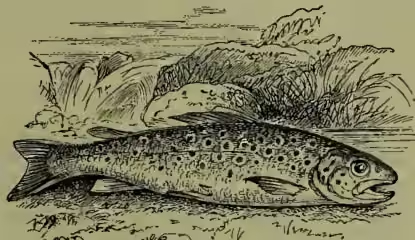
Trout, the popular name of many species of the genus Salmo, as characterised by Cuvier, some of which are referred by Valenciennes to his restricted genus Salmo, some to Fario, and some to Salar (see SALMON, BULL TROUT). The name is given to some of the silvery species migrating to the sea, which are noticed in the article SALMON, as well as to all the yellow species, which constantly inhabit fresh waters. The latter are found in almost all the lakes and rivers of the temperate and colder parts of the northern hemisphere. The Common Trout (Salmo fario or Salar ausonii) is widely diffused in the eastern hemisphere, abounding in almost all the lakes and rivers of the British Islands and the north of Europe. It is found in very small streams, ascending even to their mountain sources, but attains its largest size where there is considerable depth of water and abundance of food. A trout caught in a branch of the Avon at Salisbury weighed 25 lb., and one was caught in Loch Stenness in Orkney in 1888 which weighed 29 lb.; but such a size is very rare, and even in ponds where the trout are regularly fed they seldom exceed 10 lb. A trout of 1 lb. or 1½ lb. is reckoned by the angler a very fine fish, and many a stream swarming with trout produces none nearly so weighty. The head of the common trout is large; the eye large; the general form symmetrical, stouter than that of the salmon, the convexity of the outline of the back nearly similar to that of the belly; the tail is slightly forked, except in old fish, in which it becomes almost square, and sometimes even slightly convex. The teeth are numerous, strong, and curved, two rows of them extending along the whole length of the vomer, with no marked group at its front. The colour is more or less yellow, but the tint varies much in the trout of different waters, sometimes passing into greenish black or violet. The colour is brightest in the trout of clear streams.
On the back and upper part of the sides there are numerous spots of black and red; the belly is silvery white or yellow; the spots on the sides vary much. The fins are light brown; the dorsal fin and tail with numerous darker brown spots. The varieties which the common trout exhibits in tints and spots has led to attempts to distinguish several species; but these have not proved satisfactory to most naturalists. It is certain that the appearance of the trout is much affected by the character of the water in which it lives, and the food with which it is supplied. The trout of a river with a muddy bottom are very different from those of a clear gravelly stream, and those of a stream darkly coloured by moss are easily distinguished. The tint of the flesh varies as well as the external colours, being pink in some—the finest for the table—and white in others. Trout transferred from one locality to another soon change their tints, as they have a wonderful power of assimilating their colour to that of the medium in which they dwell.
The trout is very voracious, and readily devours almost any kind of animal food. Worms and slugs washed into rivers by rains are very acceptable to it. Small crustaceans are supposed to be the chief food of trout in some lakes and streams which are noted for the excellence of their produce. Small fresh-water shellfish, such as the fresh-water shrimp, are also a favourite food of trout; and the most beautiful trout in Scotland—those found in Loch Mulach Corry near Inchnaumph in Sutherlandshire—feed almost entirely on the fresh-water shrimp. Small fish of any kind which they can capture are their prey, and multitudes of salmon-fry thus perish. A gentleman well known to the writer of this article caught a large trout which had a very young viper in its mouth, bitten into three pieces. The leaping of trout for flies in a summer day or evening adds to the charm of many a rural scene. Small trout often throw themselves quite out of the water; the larger ones in general merely rise to take struggling flies from its surface. The angler adapts his lures to the season and the weather. In spring and summer, when the weather is fine, the artificial fly is very successful; bait, generally the worm, is used in wet weather, or when the streams are swollen by rains. The minnow is a good bait for large trout. No bait is more deadly than salmon roe, but the use of it is prohibited by law in Britain, for the sake of the salmon-fisheries (see ANGLING).
The trout generally spawns in the end of October and in November, when the lower jaw of the male becomes elongated, but not so much as in the salmon. The spawn is deposited in the same manner as that of the salmon, in gravelly beds, in running streams; and the lake-trout ascend streams for this purpose. Where trout have no access to proper spawning-ground recourse must be had to artificial means to increase the stock (see PISCICULTURE); but in some small streams their numbers seem incapable of being diminished by any amount of fair angling. The best feeding-grounds are often where there is no good spawning-ground within reach of the fish. The trout grows rapidly when it has abundant food. From instances of individuals kept in wells and ponds it is known to attain an age of thirty or even fifty years. Among the varieties of the common trout one called the Gillaroo Trout is found in Lough Neagh and other lakes of the north of Ireland. It attains a large size, is very thick in proportion to its length, and has much smaller teeth than the ordinary trout.
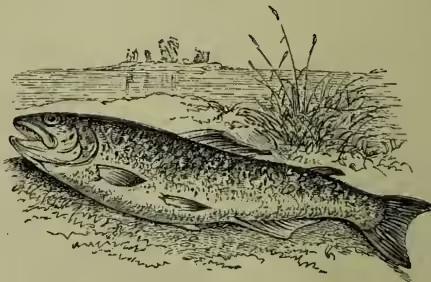
The Lochleven Trout (Salmo levenensis or S. caeifer) is found in Lochleven in Scotland, where the common trout is also found, and is distinguished from it by the more pointed pectoral fins; the much longer rays of the tail-fin, which is also more pointed at its extremities; and particularly by the number of caecal appendages, which are from forty-nine to eighty in the Lochleven trout, whilst they do not exceed fifty in the common trout. The flesh of the Lochleven trout, which attains a large size, is a rich pink colour. Lochleven (q.v.), for its size, is probably the most productive trout-loch in the world. In 1888, the best year on record, 23,516 trout, weighing 21,073 lb., were captured by the rod; and in 1891 16,058, weighing 12,830 lb., were taken. There is an artificial hatchery in connection with Lochleven; and in 1891 nearly 300,000 healthy fry were deposited in spring in the feeders of the loch. With the exception of the lake species, all British trout are more or less migratory.
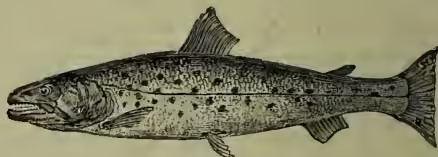
The Great Lake Trout (Salmo ferox) is the only other British species. It is found in some of the larger British and Irish lakes, and in the lakes of Scandinavia, seldom, if ever, ascending rivers, except for a short distance at the spawning season. It occasionally, but very rarely, attains a size of 30 lb., is a very powerful, active fish, and tries the skill of the angler in no small degree. It differs from the common trout in the longer muzzle, in the position of the fins, in having the tail square in all stages of growth, and in other characters. Its colour is generally deep purplish brown, passing into greenish or grayish yellow on the belly. The spots are large, and not numerous. The great lake trout feeds much on small fishes, and is as greedy as a pike. It is taken by night-lines, or by trolling with strong tackle and a small trout or other small fish (or artificial minnow) for bait. Young fish are taken with the artificial fly. The flesh of this species is inferior in quality to that of the common trout. Very different from it is the Lake Trout of the Lake of Geneva (Salmo or Fario lemanus), which is a fish of excellent quality, and nearly allied to the Salmon-trout (see SALMON). It ascends the rivers which fall into the lake, as the salmon-trout ascends rivers from the sea.
It should be stated that many persons, whose views are entitled to consideration, are of opinion that there is no specific difference between the Salmo ferox and the Salmo fario, and that the former is simply an overgrown specimen of the latter. The Loch Stenness trout of 29 lb. already mentioned tends rather to strengthen this opinion.
North America has numerous species of trout. One of them, the Common Brook Trout, or Speckled Trout (Salmo fontinalis), differs considerably from the common trout of Britain; in fact, strictly speaking, it is a char and not a trout. It abounds in the streams of eastern Canada, and in the northern and middle parts of the United States. In September 1867 Mr George S. Page caught at the outlet of Rangeley Lake, Franklin County, Maine, two male trout, one weighing 10 lb., the other lb.; and in June 1871 Mr T. L. Page caught a Fontinalis in Mooselne Maguntic Lake in the same county weighing lb. The North American Lake Trout (Salmo confinis) inhabits the deepest waters of the great lakes, and sometimes attains a weight of 60 lb. It is dark-coloured, mottled with grayish spots. Its flesh is dirty yellow, and of very poor quality. It never takes the fly, but may be caught with the minnow, or a bait of fat pork. It is more sluggish than its congeners, and affords poor sport to the angler. There are several species of lake trout in North America. The finest in quality, as well as largest in size, is the Mackinaw Trout or Namaycush (Salmo amethystus or namaycush). It is not found in Lake Erie, nor in Lake Ontario, but in Lake Huron, Lake Superior, and the more northern lakes, even in those of the arctic regions. It inhabits the deepest parts of them, except in autumn, when it resorts to shallow water for spawning. The Siskiwit Trout (Salmo or Salur siscowet) of Lake Superior is of large size, stout, thick, and of rich flavour, but so fat as to be almost unfit for food. The Red-bellied Trout (Salmo or Fario erythrogaster) of the lakes of New York and Pennsylvania, sometimes feet in length, is deep greenish on the back, lighter on the sides, which are spotted with red, the belly orange-red. The north-west of America has its own peculiar species of trout, one of which, the Oregon Trout (Salmo oregonensis), is found in almost every stream from the snowy peaks of the Rocky Mountains to the sea, and is very similar to the common trout of Europe. British trout have been acclimatised in Tasmania.
In England there is a close time for trout and char, so that no trout or char of any kind can be sold in England or Wales under a penalty between the 2d of October and the 1st February. The penalties for the capture of any trout or char during close time are not exceeding £2 for the first offence, not less than £1, nor more than £2, for the second, not less than £2 for the third, and on each conviction forfeiture of all trout and char caught. In Ireland the close season for trout-fishing extends from 29th September to the end of February. Scotland has no close time for trout (except the Water of Leith within Edinburgh), and no gauge for immature fish. There certainly should be a close time or a gauge, or both. The best period for a close time would probably be from 15th October to 1st March. Illegal methods of taking trout are discussed at POACHING.
See works cited at ANGLING; also Livingstone Stone, Domesticated Trout (Charleston, 3d ed. 1877).