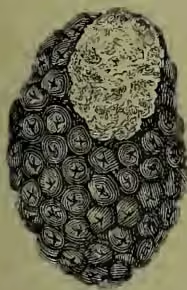
(Tuber aestivum).
Truffle (Tuber), a genus of fungi of the order Tuberacei, division Ascomycetes; globose, or nearly so; of a fleshy substance, with a distinct skin, the whole substance pervaded by a network of serpentine veins, which are the hymenium, and bear the spore-cases in minute cavities. The species are not numerous; they are very generally diffused in temperate parts of the world; they are subterranean, often found at the depth of a foot or more in the soil, usually near the roots of trees, or rarely living on the surface. Some of them are amongst the most highly valued of esculent fungi. They are said to have a stimulating aphrodisiacal quality. The Common Truffle (T. aestivum) is of a black colour, and has a warty surface. It is the principal species sold in the English markets. It varies in size from that of a large plum to that of a large potato. On account of its agreeable flavour, it is used in the preparation of many dishes. It is common in the central and southern parts of Europe, chiefly in loose soils, in woods and pastures, as in the chestnut woods of France and Italy. In England it occurs pretty abundantly in the downs of Wiltshire, Hampshire, and Kent. Truffles probably occur in many districts, but owing to their subterranean growth are unsuspected. In England, and also on the Continent in localities in which they are known to grow, trained dogs are employed to discover their whereabouts, and in France and Italy pigs are employed for the same purpose. The best French Truffle, which is considered superior to the English, is T. melanosporum. The White Truffle of Germany, which also is found in England, is Choironymes albus, a genus closely allied to Tuber, but less esteemed in cookery than the common truffle. The Red Truffle of the Bath market is Melanogaster, a genus of the allied order Hypogei, and is not therefore a true truffle. The African truffles, species of Terfezia and Tirmannia, somewhat inferior to it in quality, are in some parts of Algeria and Tunis an important food-supply for the people. All attempts at cultivating the truffle in England have hitherto failed. In the south of France they have, it is said, been produced in woods which have been watered with water in which the parings of the truffle had been steeped. As yet, however, the manufacture of spawn, as in the case of the mushroom, has been attempted in vain. In Poitou the practice prevails of enclosing a space on the downs and sowing it with acorns. When the oaks are large enough to shade the ground, it is said there is sure to be a crop of truffles. Light chalk soil appears to be preferred by truffles, and they are found most usually in beech, oak, birch, chestnut, hazel, and hornbeam woods.