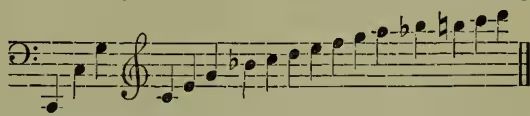
Trumpet, the most ancient of wind-instruments, is formed of a long, narrow, straight tube, bent twice on itself, the last fifteen inches tapering into a bell, and sounded by means of a cupped mouthpiece (for figure of mouthpiece, see HORN). The simple form of the instrument has been used from 'time immemorial' as a military signalling instrument, being specially attached to the cavalry and artillery branches, while the Bugle (q.v.) served the infantry. From its power and brilliancy of tone it has also been a favourite instrument with many composers of orchestral music. From the length and contracted nature of its bore its open harmonic notes (see HARMONICS) in the upper register become nearly consecutive, the effective notes being
Trumpeter (P. crepitans — the Agami of the Indians) is described by Schomburgk as occurring in large flocks throughout British Guiana, chiefly in damp forests near the coast. They are very easily tamed, and their flesh is palatable. The name trumpeter refers to 'the loud and very curious ventriloquous sound which these birds produce with closed mouth.' The same name is also applied to the whistling swans (Olor).