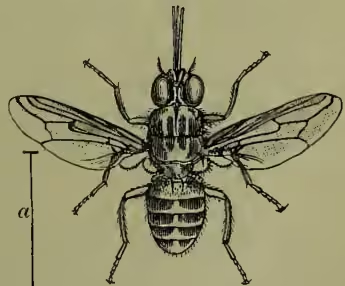
a, natural size.
Tsetse (tsc-tse; native African name of Glossina morsitans), a dipterous insect which is a terrible pest of some parts of South Africa. It is not much larger than the common house-fly, which it resembles in shape, and is of a brown colour, with four yellow bars across the abdomen. The wings in repose project considerably beyond the abdomen. It is remarkably alert, at least during the heat of the day, and dexterously avoids any attempt to catch it with the hand. Its bite is almost certain death to the ox, horse, and dog. Yet the bite is harmless to man, who feels no more annoyance than from the bite of an ordinary gnat, to the mule, the ass, the goat, and apparently to antelopes and the other wild animals of the country. The proboscis is adapted for piercing the skin, is grooved, and has a horny bulb at the base; and the fly lives by sucking blood. At first no effect is perceived; but sometimes in a few days after an ox has been bitten by the tsetse, sometimes not for weeks or even months, the eyes and nose begin to run, 'the coat stares as if the animal were cold,' a swelling appears under the jaw, and sometimes at the navel, emaciation and flaccidity of the muscles ensue, purging, sometimes staggering and madness, and finally death. No cure for the bite is known; but smearing cattle before passing through the 'fly-belts' with a paste of manure and other unpleasantness seems to some extent to ward off the fly. Nothing about the creature is more curious than the sharply-defined areas or 'fly-belts' (sometimes quite small) in which the fly is found, adjoining districts being, for no ascertainable reason, absolutely free of it. The valley of the Limpopo is a special haunt; also the region between the Transvaal and the east coast. The Zimb of Abyssinia is either identical with the tsetse, or is a similarly venomous dipterous insect.