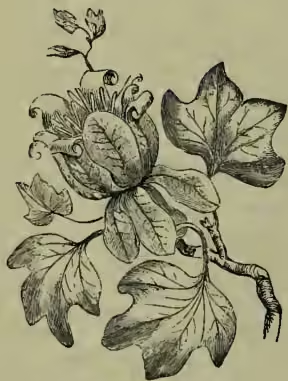
(Liriodendron tulipifera).
Tulip Tree (Liriodendron tulipifera), a beautiful tree of the natural order Magnoliaceæ, a native of the United States, having a stem sometimes 100 to 140 feet high and 3 feet thick, with a grayish-brown cracked bark, and many gnarled and easily broken branches. The leaves are roundish, ovate, and three-lobed, the middle lobe obliquely truncated. The flowers are solitary at the extremities of the branchlets; they resemble tulips in size and appearance. The bark has a bitter, aromatic taste, and, like that of all the Magnoliaceæ, contains a bitter principle, called Liriodendrin, which has been used as a substitute for quinine in fevers. The tulip tree is one of the most beautiful ornaments of pleasure-grounds wherever it grows, and flowers well—in Britain, however, only in the southern parts. It does not flower freely till the tree is from twenty to thirty years of age. It is now plentiful in many parts of the south of Europe. In some parts of the basin of the Mississippi it forms considerable tracts of the forest. The heart-wood is yellow, the sap-wood white. The timber is easily wrought, takes a good polish, and is much used for many purposes.