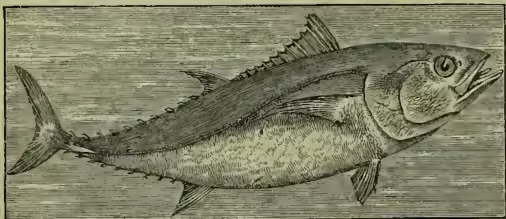
Tunny. The tunnies belong to the mackerel family, or Scombridae, and have somewhat the appearance of gigantic mackerel. There are several genera and species. The Common Tunny (Thunnus vulgaris of Cuvier, Oreynus thynnus of Günther) is the thynnus of the ancients. It is a large fish, reaching 9 feet in length, and 1000 lb. in weight. It occasionally occurs on the British coasts, but is particularly abundant in the Mediterranean. It has a large mouth with small teeth; two dorsal fins, the first elongated and reaching nearly to the second, which is shorter; behind the second dorsal and anal are eight or nine finlets like those of the mackerel. There is a keel on each side of the free portion of the tail, and the tail fin is crescentic. There are small scales all over the body, but they are larger in the anterior part, where they form a well-defined corselet. An air-bladder is present. The tunnies approach the coasts in summer, chiefly for the purpose of spawning, and it is at this time that the fishery is carried on. Like the mackerel, the fish are gregarious and migratory, but it is untrue that they all leave the Mediterranean in autumn, as was formerly supposed. The Phoenicians established a tunny fishery at a very early period on the coast of Spain, and the tunny appears on Phœnician medals of Cadiz and Carteia. Salted tunny was much esteemed by the Romans, and was called Saltamentum Sardicum. The tunny is generally captured by means of nets arranged in a funnel-like form, the fish entering the wide mouth of the funnel, and being gradually driven to the narrow end, where they are killed by lances and harpoons. The line of nets is often more than a quarter of a mile long. The principal fisheries at the present day are at Cadiz, the Gulf of Lyons, Corsica, Sardinia, Sicily, Tunis, and in the Black Sea. At Tunis most of the fish are cut up and preserved in olive-oil, and exported in tins; others are salted and sent to Malta and Sicily, but fetch only half the price of those in oil. The common tunny also occurs on the western side of the Atlantic, from the Caribbean Sea to Newfoundland. The Long-finned Tunny (Oreynus germo) is distinguished by the great length of the pectoral fins; it is scaled all over, and the corselet is ill-defined. It is much smaller than the common tunny, seldom reaching 3 feet in length. It is caught by long and strong 'whiffing' lines trailed from a boat, the fishery being principally carried on in the south part of the Bay of Biscay. A few stragglers have been caught on the coasts of Devon and Cornwall, but its ordinary range is from the Bay of Biscay to the Cape of Good Hope. The Bonito (q.v.; Thunnus pelamys) has no scales at all on its body except in the corselet. Pelamys sarda has very fine scales on the posterior part of the body, and a small corselet. Auxis rochci is distinguished by the distance between the two dorsal fins; its weight does not exceed 6 lb. A few other species of these genera occur in the Pacific and Indian Oceans.