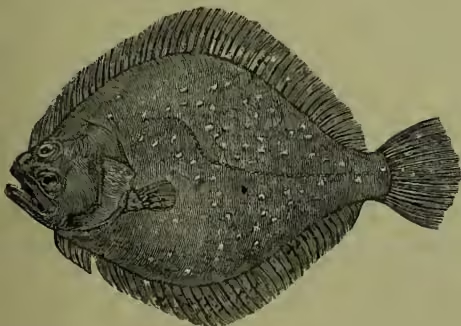
Turbot (Rhombus maximus), a fish of the family Pleuronectidae or Flat-fishes. The genus Rhombus includes the turbot and brill only among British flat-fishes: its distinguishing characters are that the eyes are on the left side, the ventral being anterior, the mouth terminal and large, with teeth on both sides, the shape rhomboidal, and that the lateral line has a semicircular curve above the pectoral fin. The dorsal fin commences on the snout in front of the eyes, and its rays like those of the ventral are branched. The turbot is distinguished from the brill by the fact that it has no scales, but on the upper side bony plates in the skin from which blunt tubercles project: it is also broader in proportion than the brill. The adult turbot is about 2 feet long, and it has been known to reach a weight of more than 30 lb. It feeds principally on other fishes, but also on crustaceans, molluscs, and echinoderms. It occurs on sandy ground all round the British and Irish coasts, becoming rarer towards the north. The largest supply comes from the North Sea. It breeds in summer: the eggs are very small and are buoyant or pelagic. Buckland calculated the number of eggs in a single female at over fourteen millions. The young, unlike those of other flat-fishes, are provided with an air-bladder, and continue to swim at the surface during their metamorphosis. At this period of life they approach the shores, and are found in harbours and bays. After the metamorphosis the young fish remain in shallow water, where also larger specimens occur in summer-time. The turbot in the market is only surpassed in price by the sole: its average price on landing in 1890 was 7d. per lb. The total value of turbot landed in that year in the United Kingdom was £58,831. Owing to its predaceous habits and large mouth, the turbot is caught on hooks as well as by the trawl. The range of the turbot extends along the coasts of France and in the Mediterranean as far as the Adriatic. Like the sole, it is entirely absent from the American coast. R. maculatus, the only American representative of the genus, found on the coasts of New England and New York, is of little value as food from the extreme thinness of the body, to which it owes its common name of 'window-pane.' It rarely exceeds a pound or two in weight. Another species, R. macticus, occurs in the Black Sea.