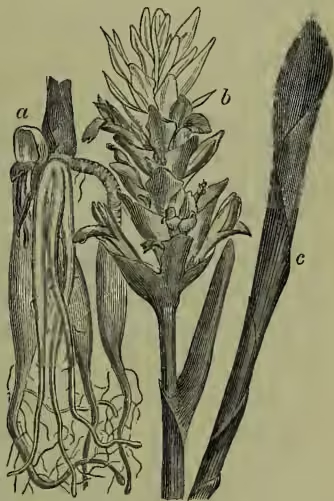
a, root; b, spike of flower; c, leaf before expansion (Bentley and Trimen).
Turmeric, the rhizome or rootstock, usually having pointed cylindrical branches, of Curcuma longa (nat. ord. Zingiberaceæ). This species of Curcuma is a handsome herbaceous plant, the flowering stem of which has long, narrow, sheathing leaves, and above these a leafy spike of yellow flowers. It is cultivated all over India, but it is also grown in the East Indian Islands, China, and the Fijis. The tubers, which are yellowish externally, yield a deep yellow powder of a resinous character. Turmeric has been long employed in the East as a medicine, and as a yellow dye which can be changed into a deep, brownish red by alkalies, but neither colour is permanent. It is a principal ingredient in some Indian articles of food, including curry-powder. In western countries it is not now much used in dyeing, nor in medicine, but it is very useful as a chemical test for the presence of alkalies, any alkaline substance quickly changing its colour from yellow to reddish brown. Mustard is frequently adulterated with turmeric, and so also are some other substances. Turmeric has an aromatic taste and a peculiar odour not unlike that of ginger. The odour is due to an essential oil called turmerol, of which the tubers contain about 1 per cent.; and the colouring principle is known as curcumin. African turmeric, brought from Sierra Leone, is obtained from a species of Canna.