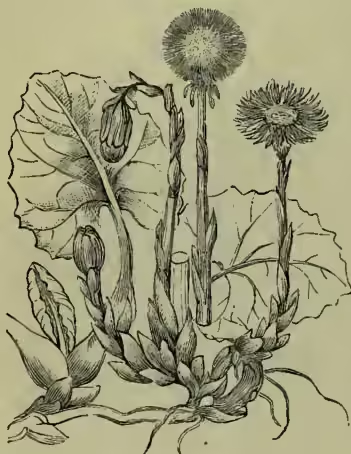
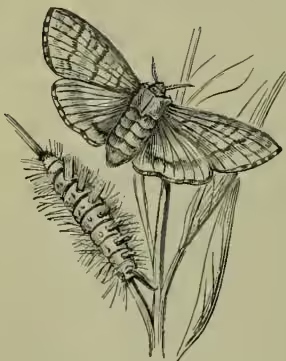
Tussila'go, a genus of plants of the natural order Composite, sub-order Corymbifere. T. farfara, sometimes called Colt's-foot, is the only British species. It has single-flowered scaly scapes, with cottony down, formerly used as tinder. The feathery pappus-hair which succeeds the flowers is eagerly sought by goldfinches to line their nests. Nearly allied to this genus is Petasites, of which one species, the Butter Bur (P. vulgaris, formerly T. petasites), is a native of Britain. The leaves resemble those of T. farfara, but are much larger; the flowers also appear before the leaves, but in a dense thyrus, and are of a pale flesh colour. The flowers of both are much sought after by bees, as are those of P. alba and P. (both formerly T.) fragrans, natives of the south of Europe, not uncommon in British flower-gardens. leaves throughout the summer, becomes a hairy chrysalis about September, and emerges as a moth in the following spring. Miss Ormerod recommends a hard syringing if the caterpillars are present in large numbers.