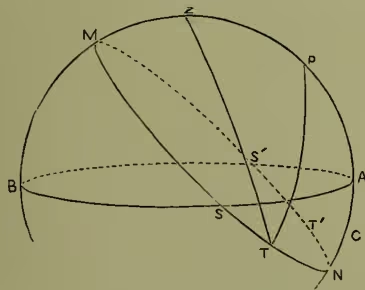
Twilight. If the earth had no atmosphere we should be involved in total darkness from the instant of sunset till the instant of sunrise. The transition from day to night, and from night to day, occupies an interval which varies with the latitude and the declination of the sun, and this intermediate stage is called twilight. As long as the sun is not more than 18° below the horizon its light is reflected by the air and the clouds and vapour suspended in it in sufficient quantity to render even distant objects visible. The question of the duration of twilight is, therefore, simply reduced to this: How long after sunset, or before sunrise, does the sun reach a position 18° below the horizon of a given place? And this can be answered easily by calculation in spherical trigonometry. Thus, if Z be the zenith, P the pole of the heavens, ASB the horizon, and MSTN the (small) circle which the sun describes about the pole; there is twilight while the sun moves from T to S, ZT being an arc of 108°. In the spherical triangle ZPT, we know the three sides, for ZP is the colatitude of the place, PT the sun's polar distance, and ZT is 108°. Hence we can calculate the angle ZPT, which is the sun's hour-angle; and from this we find at once how long before or after noon the sun passes the point T. If ZT' be also 108°, we see that it is night while the sun moves from T' to T, day while it moves from S (through M, its meridian position) to S', morning twilight from T to S, and evening twilight from S' to T'. Make ZC = 108°, then, if PN be less than PC, but greater than PA, there will be no point of the sun's path (MS'NS) so far as 108° from Z; and therefore the points T and T' will not exist. In this case the sun will set and rise, but there will be no night, or, rather, twilight will occupy the whole interval from sunset to sunrise. This cannot occur in low latitudes, but does occur during certain periods of the year in northern and southern countries. For
PN is 90° - sun's declination,
PC is latitude + 18°, and our condition is, therefore, that 90° - sun's declination, while greater than the latitude, does not exceed it by more than 18°. Or, in a simpler form, the latitude, together with the sun's declination, must lie between 90° and 72°. Now the sun's greatest declination is about 23° 30', and therefore in lat. 48° 30' (72° - 23° 30') there will be one night in the year (at the summer solstice) consisting wholly of twilight; for higher latitudes, more; and for lower, not one.