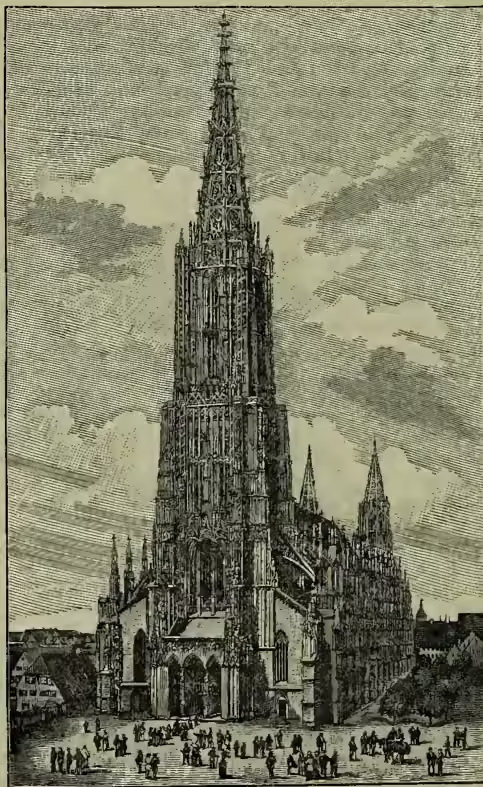
Ulm, the second city of Württemberg, 58 miles SE. of Stuttgart and 91 WNW. of Munich, on the left bank of the Danube, which here receives the Blau and the Iller and becomes navigable. On the Bavarian side of the river is New Ulm, with 7593 inhabitants. Ulm till the war of 1866 was a fortress of the Germanic Confederation, garrisoned by troops of Württemberg, Austria, and Bavaria. Its fortifications (1842-66) have since been greatly extended. The Protestant cathedral is remarkable for architectural beauty, and is, next to the cathedral of Cologne, the largest church in Germany. It is 455 feet long, 186 broad, and 134 high; the tower and open-work spire (530 feet, the highest in the world; see Vol. IX. p. 644) was only completed on 30th June 1890. The cathedral was begun in 1377, and carried on until 1494; its restoration was undertaken in 1844, and it has a splendid organ (1856-88) with 6268 pipes. Other edifices are the 15th-century town-hall, the 'New Building' (1603) on the site of a palace of Charlemagne's, and the Tentonic Knights'
Commandery (rebuilt 1718). Leading industries are the manufacture of cotton, woollen, and other textiles, of paper, leather, beer, &c. Ulm is famed, moreover, for ornamental pipe-bowls and pastry called Ulmer bread. Pop. (1871) 26,290; (1890) 36,201, of whom one-fourth were Catholics. The Romans had a settlement at this important point. In 1531 the city accepted the Reformation. Ulm was in October 1805 the scene of the defeat by Ney of General Mack, and of his surrender with 28,000 Austrians. In 1802 it was attached to Bavaria, and in 1810 became part of Württemberg. See works by Pressel (1873-78), Schultes (1881), and Löffler (1881), besides an article in the English Illustrated Magazine (1886).