Vagrants, a very numerous class of homeless persons roaming about the country, and from town to town, subsisting chiefly upon what they can beg or steal. In Great Britain it is reckoned that there are at least 60,000 vagrants. The nomadic life led by these waifs seems to possess a charm for them which proves irresistible, and they very rarely settle down to a regular occupation after they have been any length of time wandering. Vagrants have been known as a class for many centuries; and in almost every part of the world evidence has been obtained of the existence from remote times of wandering beggars whose mode of life bears striking resemblance to that of the vagrant of the present day. The Gypsies (q.v.), while having many of the same characteristics, do not usually associate with the ordinary vagrants, but belong to a class quite distinct and exclusive.
One of the most interesting and instructive records to be found concerning vagrancy is the Liber Vagatorium, The Book of Vagabonds and Beggars, edited by Martin Luther, and published in 1529 (Eng. trans. 1860). In it he gives a minute description of the various kinds of vagrants who were then known in the north of Europe, which may be condensed as follows:
(1) Beggars, or those who plainly and simply went about asking alms. (2) Bread-gatherers, who went about with their wives and children with them, dressed in ragged garments, collecting food, &c. These carried cooking utensils, &c. as a part of their equipment, and neither they nor their children ever left off begging from their infancy to the day of their death. (3) Liberated prisoners, who excused themselves for begging by saying they had been unjustly deprived of their liberty and character, and thus prevented from earning a different livelihood. (4) Cripples, many of whom shammed lameness or deformity. (5) Church mendicants, producing false credentials to show that they were collecting alms for religious purposes. (6) Learned beggars, young scholars or students, who said they had naught on earth but the alms wherewith people helped them, and which they would use in furthering their studies for the church or some of the professions. (7) Pretended murderers, who asserted that they had taken a man's life away, and had afterwards been seized by remorse, though it was in self-defence, and that this had driven them to a wandering life. (8) Wives of the above. (9) Lepers, or those suffering from loathsome diseases. (10) Spurious beggars, who pretended that like the Capuchin friars they were voluntarily poor. (11) Pretended noblemen and knights, who travelled about well dressed, saying that they had suffered by war, fire, or captivity, or had been driven away and lost all they had. (12) Pretended merchants, who produced documents to show that they had been possessed of merchandise which they had lost. (13) Baptised Jewesses who had turned Christians. (14) Pretended pilgrims. (15) Beggars suffering with sores. (16) Strollers professing to country-people that they were possessed of magic power, and could prevent murrain, &c. (17) Knaves with falling sickness, who took fits and assumed sudden illness. (18) Invalids alleging that they had suffered for years with incurable ailments, or whose wives or families were alleged to be so afflicted. (19) False begging priests. (20) Blind beggars. (21) Naked beggars, whose apparel was so very scanty as to arouse universal pity. (22) Silly or half-witted beggars, who, while apparently bereft of some of their mental faculties, were generally 'more knave than fool.' (23) Hangmen, who had given over their hateful avocation. (24) Women so clothed as to lead to the belief that they were pregnant. (25) Mendicants who besmeared themselves with a yellow fluid to simulate jaundice. (26) Vagrants professing to be doing penance. (27) Blind harpers. (28) Goose-shearers, or those who put on good clothes and begged, saying that they had lain ill a long time, and were mechanics who had expended all their goods, and were ashamed to beg, but asked that they might be helped to proceed on their journey.
If one makes allowance for the changes which have taken place in the manners and customs of the people and in their modes of living, the similarity which exists between the modern vagrant and many of those described by Luther is apparent. Perhaps the most crafty of the vagrant class of the present time are to be found among the begging-letter impostors whose carefully worded epistles so often succeed in extracting contributions from the charitable. The cause assigned for these appeals is generally the death of a wife, husband, or child, or the distress which has been caused by accident or illness. The begging-letter writer generally carries on the business in such a manner as to make sure that, by the time the local police have been communicated with, the gains have been secured, and a new field of operations has been found in a distant part of the country. A considerable number of 'Indian natives' are to be found in Great Britain and over the continent of Europe who may be classed as vagrants. They go from place to place, dressed in their native costume, and subsist on the profits of small articles which they sell at street corners, and by exhibiting a printed card hung round the neck. The dress they wear, their dusky skins, and their want of knowledge of the language of the country in which they are found, form sufficient capital to enable them to live in comparative comfort, and in numerous cases even to set aside enough for their wants in old age. Representatives of this class are constantly to be found in all the large cities in the United Kingdom. Many other kinds of vagrants might be described, the most numerous amongst those not included in Luther's list being the 'Patterers' or street singers, or speech-makers, to be found in almost every country. Luther's list, however, embraces most of the vagrants of the present day. There are still the same freemasonry, slang, nicknames, and practices which formed so striking characteristics of the vagrants in the olden time. The introduction of mechanical labour, the facilities of communication between places at a distance, and the operations of the poor-laws have, however, brought about great changes among the wanderers, and the ranks of the vagrants have been swelled, especially during the last half-century, by a vast number of unsteady and unskilful workmen and labourers who are continually travelling from town to town 'in search of work.' Many of these degenerate from the 'tramp' into the habitual vagrant, whose habits they become daily familiar with. The habitual vagrant is known to the tramp as a 'moucher,' while the tramp is known as a 'traveller.' The 'common lodging-houses' to be found in all large cities are the meeting places where the 'traveller' and the 'moucher' foregather, and there is too much reason for believing that the constant recital of experiences in begging, &c. to irresolute and unsteady tradesmen is gradually increasing the enormous army of vagrants by which the country is overrun. These 'common lodging-houses' are known to their frequenters as 'doss-kens,' and those of them resorted to by juveniles as 'padding-kens.' In them the plans of operation and different routes to be followed by the begging and thieving fraternity are generally arranged, and the chances of different neighbourhoods discussed. In many of them will be found rough maps or charts showing the various roads, the houses on the way, and the chances of success which each provides. If no map or chart is to be found, there is generally no lack
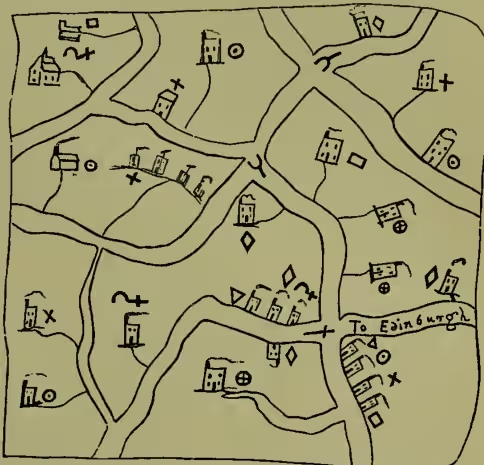
- ↯ Go in this direction ; the other road not good.
- ▽ Spoiled ; too many vagrants call.
- ○ Dangerous ; likely to be given in charge.
- ✕ Too poor ; give nothing.
- ◇ Good ; safe for something if you don't talk much.
- ⊕ Religious but kind.
- ↯ Stop. If you are selling what they happen to want, they'll buy ; they are cute.
- □ Mind the dog ; may give you in charge.
- † Cross sticks put by Gypsies and tramps at the junction of roads to show in which direction their friends have gone before them ; the long limb pointing the way.
of means of information in the persons of old members of the fraternity, who in accordance with their traditions are bound to furnish their brethren with all the assistance they can in the pursuit of their calling.
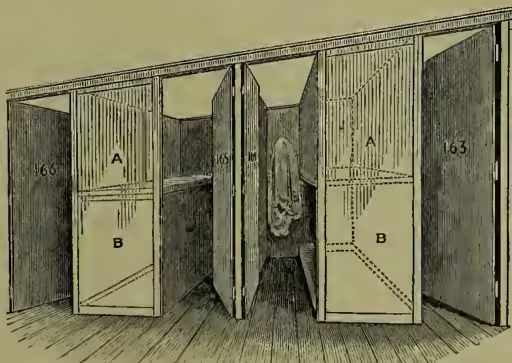
Great improvements have been made of recent years in the construction of these lodging-houses, especially regarding the sleeping accommodation, and many of the most objectionable features of the old 'doss-ken' or 'padding-ken' have been removed. More regard is paid to decency, and in many of those of the best class each of the inmates is by an ingenious economising of space provided with a private apartment for sleeping. The bunks are arranged in rows in large apartments ; fig. 2 shows part of one of the rows. The beds AA, BB, shown by the dotted lines, are one above the other, and have access from separate doors. In the figure Nos. 163 and 165 have the upper beds AA, and 164, 166 the lower, BB. The top of the structure being several feet from the ceiling ensures ventilation. The beds are 6 feet by 28 inches. Although separate sleeping quarters are now provided, the kitchen is still, however, an apartment in all common lodging-houses where the inmates meet together. In it the vagrants discuss their plans of operation each night, and arrange their 'work' for the following day, so as to interfere as little as possible with each other's 'business,' and their respective 'walks' are assigned with as much deliberation and care as if they were conducting legitimate trade.
Statutes for the suppression of vagrancy have been in force for many years, the principal measures in existence in England being 5 Geo. III. chap. 83, 1 and 2 Vict. chap. 38, and the Vagrant Act Amendment Act of 1873. These acts cannot be said to have materially affected the growth in numbers of the vagrant class, while it is to be feared that in many places the existing arrangements under the poor-laws have given direct and material support to vagrancy. The 'casual wards' which have been provided have been largely used by the 'mouchers,' who have thus been relieved of any anxiety they formerly had as to being able to secure sleeping quarters and a morning's meal. The shelter and society which the casual ward provided were found to act so powerfully in attracting the vagrant class that various methods had to be adopted for counteracting these influences. Tasks of work were exacted, and relief was refused to all able-bodied young men unless they produced certificates of character from some person in a public position, or unless the workhouse officials were satisfied they were actually destitute. These rules, however, are now only partially enforced, although in some places the task of work is still carried out, and in others admission is only given to the casual ward on the production of a pass from the police. Great difficulty is experienced in discriminating between genuine workmen travelling in search of work and idle, habitual tramps. Where the police have been employed as relieving officers this difficulty has been best overcome, and it is generally believed that if this course were universally followed a great improvement would be effected, and many of the inducements held out to vagrants by the present system would be removed. Experience in some parts of the United States, where the slang and the hieroglyphics of the tramps are practically identical with those of the English fraternity, proves that, while proper regard has been had to the difficulties of the genuine working-man on tramp, a firm administration of the law by the infliction of exemplary sentences upon habitual vagrants has had quite a phenomenal effect in reducing the number of that class.
See John Awdelay, The Fraternity of Vacabondes (1565; ed. by Furnivall, 1869 and 1880); Thomas Harman, Causeat for Vagabones (1568); H. Mayhew, London Labour and the London Poor (4 vols. 1851-61); Avé-Lallemant, Das Deutsche Gaunertum (4 vols. Leip. 1858-62); C. J. Ribton Turner, History of Vagrants and Vagrancy (1887); Paulian, The Beggars of Paris (trans. 1897); and the articles CHARITIES, MENDICANCY, SLANG, SHELTA, POOR-LAWS, and HAWKERS.