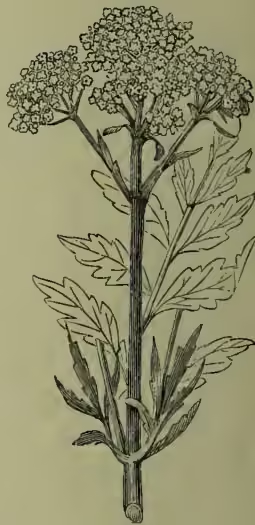
Valerian (Valeriana), a genus of plants of the natural order Valerianaceæ, an order of exogenous plants, containing nine genera and about 300 known species, natives of temperate climates, chiefly of Europe, the mountainous parts of India, and South America; annual or perennial herbs, sub-shrubs or rarely shrubs, with opposite leaves, destitute of stipules, and small flowers in cymes. They are nearly allied to Dipsacaceæ (see TEASEL) and Compositæ, but differ in the mode of inflorescence, and in the seeds being destitute of albumen and other intrinsic features. The genus Valeriana is distinguished by a pappus-like calyx, a spurless corolla, and three stamens. The species are pretty numerous. The common Valerian (V. officinalis) is abundant in ditches, moist woods, &c. in Britain, throughout Europe, and in northern Asia, and is cultivated in the United States. It has a fleshy root, pinnatifid leaves, a stem 2 to 4 feet high, and pale flesh-coloured flowers. The root is a well-known medicine, which possesses powerful antispasmodic and stimulant properties, and a very considerable influence over the nervous system (being used in hysteria, chorea, &c.). Cats are very fond of it, and it exercises a remarkable stimulating and intoxicating power over them. Although the plant grows chiefly in damp soils, the root is most powerfully medicinal in dry hilly ground. The chief ingredients of valerian are woody fibre, resinous and gum-like matters, and a little more than 1 per cent. of a volatile oil, in which valerianic or valeric acid (also obtained from several other sources) is developed on exposure to the air. Some of the salts of valerianic acid act with more certainty than the tincture and other official preparations.
The Small Marsh Valerian (V. dioica) is much less powerful than the common species. The Greater Valerian (V. Phœ) grows in alpine districts of the continent of Europe, and is perhaps the V. dioscoridis of the Greeks. V. celtica and V. salinica, gathered on the mountains of Styria and
Carinthia, are used in India to aromatise baths, and as a substitute for Spikenard (q.v.). V. sitchensis, a native of the north-west of America, possesses the medicinal properties of the genus. The root of V. edulis, a species found in the north-west of America, was an article of food with the Digger Indians. Corn Salad (q.v.) or Lamb's Lettuce belongs to the order Valerianaceæ; and Red Valerian is Centranthus ruber.