Venice (Ital. Venezia), the 'Pearl' or 'Queen' of the Adriatic. In the 5th century the Veneti, expelled by Lombards and Goths from Padua, Altinum, and Aquileia, found refuge in the islands of the lagoons, making Malamocco their chief port and their seat of government, afterwards (9th century) transferred to Rivo-Alto, the nucleus of Venice. Tradition places its first buildings on the site of the Basilica of S. Mark, and these now cover more than seventy-two islets, or rather mud-banks, their foundations being piles ('time-petrified') and stone. Through its two unequal portions winds for over 2 miles the Grand Canal (Canalazzo), spanned by the Rialto bridge (of stone) and two others (of iron), and from its outer rim flow into the Canalazzo 146 lesser canals, all bridged at frequent intervals.
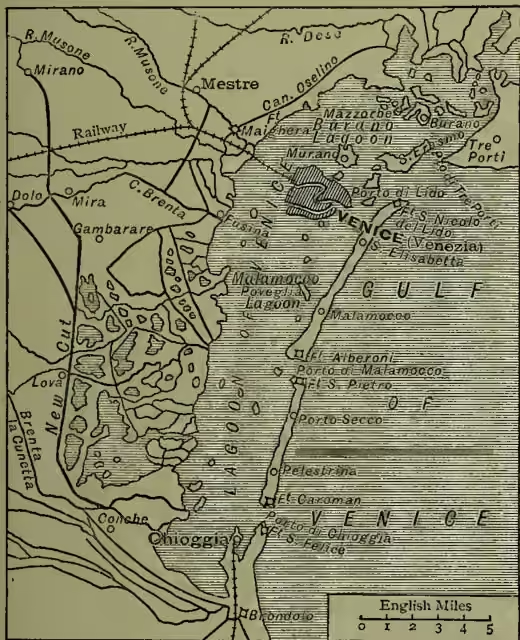
This vast network of waterway is patrolled by countless gondolas ('the hansom-cab of the Adriatic'), while the pedestrian has his choice of innumerable lanes (calli), making every house accessible sooner or later on foot. A railway viaduct (1845) 2½ miles long connects Venice with the mainland, it being 165 miles E. of Milan, 71 ENE. of Mantua, and 181 NNE. of Florence. Its population, from well-nigh 200,000 in the 15th century, dwindled to 100,000 in the 18th, but has since increased to 158,019, speaking a dialect differing from the more masculine Tuscan in eliding the consonants and running the vowel-syllables into one, figlio, for example, becoming fio, and casa, ca. Its industries are its famous glass manufacture, useful and ornamental; jewellery and embroidery in gold and silver; lace, velvets, and silks; candles of wax and spermaceti; soap, sugar, and confectionery. Printing, once its most honourable tradition, is now reviving; while the ship and boat building required for its fishing and pilot-service has, since its restoration to Italy, been supplemented by ironclads, of which several first-class specimens have left its arsenal. Besides an increasing coasting trade, employing over 30,000 tons of shipping, Venice imports from Great Britain coal, iron, and, in much less quantity, fish and manufactured goods; but in spite of engineering intervention it will never regain its historical distinction as a seaport. The alluvial discharge into its gulf has greatly and irregularly reduced its depth of water, its lagoon looking at low ebb (the tidal variation being between 2 and 3 feet) like so many acres of mud. The lagoon is connected with the sea by four entrances, of which the Lido and Malamocco are the most important. Measured even by Italian death-rates Venice is not healthy, but with the drinking-water now supplied from the mainland it is improving. Its prelate still bears the proud title of patriarch.
Detailed reference to all its attractions, architectural, artistic, and historical, belongs to the guide-book, but Venice possesses features distinctive enough for brief notice here. Such are its Piazza di S. Marco, the north side formed by the Procuratie Vecchie, surmounting an arcade of fifty arches, erected 1517, as the residence of the nine procurators of S. Mark, from whom the doge was usually elected. For the increasing number of these dignitaries were built the Procuratie Nuove, on the south side of the Piazza, now constituting a portion of the Palazzo Reale. Of this the library hall is a masterpiece of Sansovino, its ceiling decorated by the seven best Venetian artists of the time (1582), while Titian, Paul Veronese, Bassano, and Tintoretto contributed splendid work to other parts of the interior. The Campanile, begun 902, completed by the belfry 1510, commands from its altitude of 323 feet a glorious prospect. The clock-tower, on whose dial two bronze figures strike the hours upon a bell, gives entrance to the Merceria or main business quarter, threaded by streets converging towards the Rialto. In front of S. Mark's itself rise three red flagstaffs, surmounted by winged lions. From these once floated the silk and gold banners typifying Candia, Cyprus, and the Morea, the three possessions of the republic, now replaced on festas by the flag of Italy. Only less supreme in interest than the Basilica of S. Mark's is the Doge's Palace, which, dating from the 10th and 11th centuries, has been extended and modified, and even in 1892 was being restored. Successive conflagrations have destroyed the paintings by the Bellinis, Carpaccio, Pordenone, and Titian, which ennobled its vast chambers, but its outer shell, particularly the east aspect towards the Bridge of Sighs, commands universal admiration. Ruskin's Stones of Venice has familiarised the world with the beauty of its details, its columns with their capitals particularly; but from these and the Porta della Carta of the main entrance, the Scala dei Giganti, and the Scala d'Oro, we must hasten if only to give a glance at the Sala del Maggior Consiglio, and at what remains of the vivid and impressive touch of Titian, Bassano, Tintoretto, Paolo Veronese, and Palma Giovane, who lavished their genius on its walls. The celebrated Library or Biblioteca di San Marco, transferred (1817) from the above-described library hall of the Palazzo Reale, contains 120,000 volumes and 10,000 MSS.—the latter at one time including the codex of Homer, bequeathed by Petrarch, who had received it from Nicolaos Sigeros, ambassador from the Greek emperor, but since destroyed with all the others of Petrarch's bequest. The Museo Archeologico, also shorn of much treasure, among it the maps of those countries explored by Venetian travellers, and originally drawn by the great geographer Gian Battista Ramusio (1485–1557), still repays many a visit, if only for its Mappamondo in which the Canaldolese monk Mauro embodied a geographical encyclopaedia of the information accessible up to 1457. Other rooms, the Sala della Bussola (antechamber to the Council of Ten), the Sala del Consiglio dei Dieci itself, the Sala del Senato, and the Sala del Collegio (to mention the more famous of them), have each their special associations and attractions historical or artistic, the interest deepening as we mount to the Sotto Piombi ('under the leads') where Casanova and Silvio Pellico languished, or descend to the Pozzi ('wells') which shadow many a page of Venetian history, or emerge from the Doge's Palace to cross the Bridge of Sigls and enter the Carceri or public prisons, sombre as their destination and their records. The Zecca or Mint (now the Bourse) and the granite columns, one bearing the Lion of S. Mark, the other S. Theodore, have infinitely less to detain us than the Basilica di S. Marco itself, placed by Canova above the cathedrals of Pisa and Siena as, on the whole, the first of the three finest churches in Italy. Signor Ongania's magnificent folio, La Basilica di San Marco Esposta (1883), does not suffice to exhaust the interest surrounding and pervading this wonderful edifice, of which the external mosaics, the bronze horses, the interior (also ennobled by its mosaics), the choir, the sacristy, the north transept, the baptistery, the treasury, and the pavement have each their special students and art-votaries, whose admiration a life-long succession of visits seems only to deepen and refine. Dwarfed by comparison, the remaining churches of Venice, formerly more numerous than the Roman ones in proportion to population, need now be noticed only in groups, of which there are four—the first, Gothic in style, exemplified in the plain, massive, and solemn church of the Frati; the second, the so-called Lombard (really a revival of the 15th-century Romanesque), of which the church of the Miracoli is the type; the third, the Italian, locally termed 'classical,' seen at its best in the Palladian Redentore; and the fourth, or modern Italian, ornate to excess, represented by the church of the Salute. Many of these are individually attractive, over and above their history or destination, by artistic chefs d'œuvre; that of the SS. Giovanni e Paolo was long famous for its masterpiece by Titian (the 'Death of Peter Martyr'), destroyed by fire in 1867, and replaced by an old copy; and still is for its neighbouring statue of Bartolommeo Colleoni, general of the republic (1475), which, designed by Verocchio and cast by Leopardi, is reckoned the finest art-product of its kind in the world. The church of San Rocco has also a reflected interest from its Scuola hard by, rich in magnificent Tintoretos.
To the museums and picture-galleries, which, as in times past, will always attract the student of painting, we can do even less justice than to the public buildings and churches—the interest of the former consisting in a wealth of chefs d'œuvre, around which a whole library of criticism and controversy has for more than a century accumulated. The Accademia delle Belle Arti is annually thronged for its Bellinis (Gentile and Giovanni), its Carpaccios, its Giorgiones, its Palmas (Vecchio and Giovane), its Paolo Veroneses, its Tintoretos, and its Titians; while the Museo Civico, infinitely less attractive in painting, never fails to reward the visits of the lover of majolicas, gems, carvings, autographs, miniatures, and other rarities bequeathed to the city in 1830 by Teodoro Correr. Interest of a sterner kind clings to the arsenal, founded in 1104, busy with 16,000 artisans in the 16th century to maintain the supremacy of the republic afloat, now employing 2000 workmen as the third dockyard for ships and ironclads in Italy. Its museum forms a running commentary on Venetian history, containing the model of the Bucentaur (q.v.) from which the doge every Ascension Day solemnly espoused the Adriatic. From the arsenal to the Grand Canal, with its rows of palaces on either side, we return to artistic Venice, the palaces themselves, notably the Palazzo Manzoni (15th century), the Palazzo Corner (16th century), the Palazzo Rezzonico, the Palazzo Foscari, the Palazzo
Pisani a S. Polo, the Palazzo Contarini, followed by the three Mocenigo palaces (the centre one occupied by Lord Byron), the Palazzo Corner Spinelli, and the Palazzo Grimani, down to the Rialto Bridge (beyond which are the Palazzo Camerlenghi and the Palazzo Vendramin Calerghi), all recommended in divers ways for their architectural beauty, their interior arrangement and ornamentation, and their family associations closely linked with the fortunes of the republic. Other palaces of repute are the Palazzo Giovanelli, with its far-famed landscape, in which the nude figures are by Giorgione; the Palazzo Trevisan; and the Palazzo Moro, the traditionally-credited abode of Shakespeare's Othello. In theatres Venice is comparatively poor, La Fenice being the principal one; but in public gardens and islets adapted for holiday purposes it abounds. The Littorale di Malamocco, facing the city across the lagoon (the so-called 'Lido'), is an immensely popular resort, particularly during the bathing season, when it presents a very different aspect from the lonely, haunted-looking strand so dear to the misanthropic mood of Byron. This and the islets Murano (q.v., renowned for its glass), Torcello, and Burano (q.v., employing 300 girls in the celebrated lace-industry) are easily accessible by the steamers and steam-launches which—the latter especially—seem likely to replace the picturesque but much slower and more expensive gondola, not only in the Adriatic but within the city itself.
History.—Venice rises to historical importance 697 A.D. when its island-communities, governed for 240 years by annually elected tribunes, superseded these at the instance of Cristoforo, patriarch of Grado, by a Duke or Doge of absolute authority in church and state, during peace and war. Paolo Lucio Anafesto, first of the long line of Doges, ruled the republic with power and wisdom, suppressing faction, and acquiring from the Lombards a foothold on the mainland. Orso, the third Doge (720–37), gained further advantages over the Lombards, whom he compelled to reinstate the Exarch of Ravenna, for which service the Byzantine emperor honoured him with the title of Ipato (Hypatos) or imperial consul. Gravitating through political interest to Constantinople, Venice opposed the policy of France in the Adriatic and incurred the enmity of Pepin, whose fleet blockaded the Venetians in the central island (Rialto). But the ebbing tide left the invaders stranded off the islet of Albiola, where the light flotilla of Venice annihilated them. From the Rialto, now (810) the seat of government, the Doge Agnello Partecipazio ruled all the neighbouring islets, connecting them with bridges, and forming the modern Venice. Having acquired the relics of S. Mark (827), the Doge Giovanni I. Partecipazio made the evangelist the tutelary saint of Venice, and began (829) the building of his cathedral. A long interval of comparative peace favoured the maritime and mercantile expansion of the city. Istria and Dalmatia were conquered, while commercial relations were opened up with the west and still more with the east as far as the Crimea and Tartary, and made Venice a dominant power in the Levant and one of the leaders of the crusades. Ostensibly religious, but really commercial, this latter enterprise of the Venetians left them stronger in the Mediterranean than ever. Meanwhile the city itself, reduced to ashes by successive conflagrations, replaced its wooden by stone edifices, in which marble from Italian and Dalmatian quarries figured largely, and laid the foundation of those palaces since one of its characteristic features. Extended relations abroad provoked inevitable wars. The crusading expedition of the Doge Faliero, followed up by his successor Domenico Michele, riveted the power of
Venice in Syria by the reduction of Tyre, and eventually brought the republic into collision with the Byzantine emperor Joannes Comnenus, who decreed the suspension of all intercourse between the two powers. Resorting to swift reprisals, Venice next year (1123) punished the empire by the capture of Rhodes, besieged or sacked the Cyclades, Sporades, and Ionian islands with part of the Morea, and once more reduced Dalmatia, instigated by the Hungarian king to revolt. Siding first with the German emperor and then with the pope, the republic witnessed the meeting of the two (Frederic I. and Alexander III.) within its walls, and was confirmed by the latter in its eternal dominion of the sea. This triumphant policy, diplomatic and strategic, was the work of the Doge Ziani (1172-78), who also improved the city by laying out the Piazza di S. Marco. Enrico Dandolo (q.v.) reduced Trieste, reconquered Zara, and headed the fourth crusade, nominally for Palestine, really against Constantinople, which he stormed. He thus brought about the partition of the Greco-Latin empire, of which Venice received the lion's share—a large slice of Greece and its islands, with a foothold in the Balkan Peninsula, on the Hellespont, and in Constantinople itself, of which a fourth part was reserved for Venetian occupation, protected by Venetian laws and absolutely unrestricted as to trade. To this period belongs the embellishment of the city with the art-treasures of the east—its palaces receiving the care which a territorial aristocracy bestows on its lands, and employing a new and noble school of artists to celebrate the triumphs of the Doges.
Under the second Ziani (1205-29) arose the hostilities with Genoa, culminating in the ten years' naval war in which Dandolo succumbed to Doria, and Venice, shattered at sea, witnessed the re-occupation of Constantinople by Michael Palaeologus, with whom the republic had to make truce. The abolition of the old laws regulating the election of the Doge caused the conversion of the republic into an aristocratic oligarchy (1297), whose malgovernment led to conspiracies, the most formidable being that of Quirini-Trepolo, which proved abortive, but gave direct occasion to reforms. Among these was the establishment of the Council of Ten (1310), declared a permanent body in 1335. The mercantile prosperity of this period was reflected in the ornamentation of the city, and an enlargement of the arsenal, whence Francesco Dandolo sailed against the Turks. Andrea Dandolo put down revolt in Candia and Zara, though this was supported by Hungary. The latter Doge's great capacity as a thinker and man of letters appears in his Venetian Annals—a model of mediæval history. In 1348 an earthquake upheaved the lagoon, and a seven month's pestilence ensued—the flood and the disease destroying two-fifths of the population and fifty patrician families. To the memorable conspiracy headed by the Doge Marino Faliero (q.v.) the 14th century owes much of its interest, enhanced by the commercial rivalry between Genoa and Venice which culminated in naval battles alternately in favour of either side, till Genoa followed up its latest advantage by seizing the island of Chioggia (1379). Venice in turn became the aggressor, starved the Genoese to the point of surrender, and accepted from them an unconditional capitulation (1380). Sixteen years thereafter Genoa became the dependant of France, and was no longer the effective rival of Venice, which in consequence reassumed its supremacy at sea in war and merchandise, trading with every European country, and with the east as far as India, importing from England the iron of Staffordshire, the tin of Cornwall and Devonshire, and the wool of Sussex. The close of the 14th and beginning of the 15th century saw the Venetian arms triumphant on the Italian mainland, till under the Doge Foscario (1423-57) the long war with Milan was concluded by a peace, and a league of the Italian states was formed (1454) for the mutual safeguard of their possessions. The later half of the 15th century was chiefly occupied with hostilities against the aggressive Turks, with inter-Italian broils in which petty duke and sovereign pontiff figure, now as enemies, now as allies of Venice, and with a war with France closed by treaty (1499).
The 16th century opens with the oligarchy at the zenith of its power, but this was of short duration. The discovery of America and of a passage to the East Indies began to tell upon its trade, and the constant drain of wars, local and imperial, was not met by the diminished revenue from abroad. Incessant collisions on a great as on a small scale brought about by the League of Cambrai impaired commerce and industry, necessitating an undecided policy between the great belligerents Charles V. and Francis I., and an unprofitable neutrality in the religious agitations of Europe. In the 17th century the pressure of Austria became such as to force the oligarchy to side with the enemies of that power—with Henry IV. of France, with Bethlen Gabor and Ragotski, with the Duke of Savoy against Spain, and with the Protestants against the Catholics of the Grisons. In 1644 began the twenty-five years' war in Candia, in which the Venetian admirals defeated the Turks in a succession of mighty engagements, resulting in future successes in Greece and Illyricum in which the highest name is that of the Doge Francesco Morosini, who, after heading his fleet triumphantly for the third time, died at Nauplia (1694). Neutral in the war of the Spanish succession, Venice became again embroiled with Turkey, and lost the Morea and its hold on Candia (1718). Gradual decay marks its subsequent history: its policy became feeble throughout the 18th century, its commerce had sunk irretrievably; so that in 1796 Napoleon found nothing but the shadow of its former self on his invasion of the city. By the shameful treaty of Campo Formio the Austrians became its masters (1798), and again by the Congress of Vienna re-occupied it in compensation for the Belgian provinces. Its revolt of 1848 and heroic defence by Daniel Manin led up to its final cession (1866) to Napoleon III., who handed it over to Victor Emmanuel—the last state but one to become absorbed in united Italy.
See, besides works already cited, C. Yriarte, Venice: its History, Art, Industries, &c. (Eng. trans. 1879); Daru, Histoire de la Republique de Venise (4th ed. Paris, 9 vols. 1853); and Horatio Brown, Venetian Studies (1887), succeeded by his larger History of Venice; to which may be added A. J. C. Hare, Venice (1884); Mrs Oliphant, Makers of Venice (1887); Molinier, Venise (Paris, 1891); W. D. Howells, Venetian Life (New York, 1866; new ed. 1885); H. F. Brown's Historical Sketch (1893); and Alethea Wiel (1894). See also the articles ALINE EDITIONS, CONTARINI, CORNARO, DANDOLO, FALIERO, MANIN, SARPI, and PAINTING, p. 699.