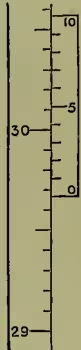
Vernier, an auxiliary scale which facilitates the accurate reading of linear or angular scales. It was invented by Pierre Vernier (1580-1637), who spent most of his life in the service of the king of Spain in the Low Countries. Suppose we have a scale of inches graduated to tenths, and that we wish to measure accurately to hundredths. We must make a small scale, the vernier, with ten of its subdivisions equal either to nine or to eleven of the small divisions of the principal scale. It is evident that each division of the vernier is smaller (or greater) than each division of the scale by of that division—i.e. by of an inch. To use the instrument the vernier must be slid along parallel to the scale until its zero line comes opposite the position to be measured. The figure shows the position of the vernier for the reading 29.67. Here the zero of the vernier lies between the graduations 29.6 and 29.7. Running our eye up the scale we see that the seventh graduation on the vernier is exactly opposite a graduation on the scale. Hence the sixth on the vernier must be higher than the next lower graduation on the scale by , the fifth by , and so on to the zero of the vernier, which will be found accordingly to lie higher than 29.6. Verniers are not always constructed so simply as that just described; and on beginning to work with a graduated instrument the operator must by inspection discover the law of the vernier. For example, in the best forms of barometer the principle scale is graduated to half-tenths, and the vernier is so constructed as to have twenty-five divisions corresponding in total length to twenty-four on the scale. Each vernier division is less than each scale division by of of an inch—i.e. of an inch. The vernier graduations are named in order—0, 2, 4, 6, and so on to 50. Thus, if the vernier zero stands between 29.65 and 29.7, and if the vernier graduation 24 is exactly opposite a scale graduation, the reading is 29.65 + .024, or 29.674. It may be that 24 lies a very little above a scale graduation, and the next vernier graduation, 26, a little below the next in order. The reading would then be 29.675. It is thus possible to read to thousandths of an inch, although the vernier is graduated so as to give only of an inch. The vernier has long superseded all other methods of accurate subdivision, and is an indispensable equipment of barometers, theodolites, sextants, and all astronomical and surveying instruments. See GRADUATION, and SCALE.