Veterinary Medicine. The ancients—more particularly Homer and Xenophon—wrote about horses and their management; Virgil's Georgics show close observation of the domestic animals and their ailments; and the Latin term veterinarius is as old at least as the 1st century A.D. Hippocrates, the father of medicine, wrote a treatise on the veterinary art; but its true founder was Vegetius, who wrote De Arte Veterinaria, 300 A.D. This work became the oracle of succeeding ages. He was sufficiently liberal-minded to give due credit to Columella and other writers who had preceded him. For many centuries after Vegetius but few writings are known to have appeared, and of these but few extracts now remain, collated by order of Constantine Porphyrogénitus. To a somewhat later date may belong the first application of iron shoes to horses' feet, and the maker of the shoes was entrusted with the medical care of the horse; hence the term farrier, 'a worker in iron,' still sometimes given to the veterinarian.
In the 16th century the necessity for a higher cultivation of the veterinary art appeared evident, and Francis I. ordered Constantine's collection to be translated from the Greek into Latin by Ruelli, a physician. From Latin it was soon translated into Italian, French, and German, and became dispersed over Europe; nearly at the same time the works of Vegetius appeared in several languages, and from this period the art made gradual progress. Gessner compiled from Aristotle, Pliny, Columella, Vegetius, and others; soon after Laurentius Ruffius wrote some celebrated works in Latin; and later on appeared the Natural History of the Ruminantia and the Phenomena of Rumination by Emiliano. During the 17th century the art continued to advance, and numerous treatises were written upon it, the most notable being César Fiarchi's work on horsemanship, in which is introduced the most rational mode of horseshoeing then practised—he condemned the use of calkings. Carlo Ruini (Bologna, 1598) published the Infermità del Cavallo, e suoi Remedii, from which Snape and Gibson in England, and most of the French authors, have copied their anatomical plates. In 1654 the Grand Mareschal François, said to be composed by several authors, appeared, and in the latter end of the century Solleysel published an elaborate work. Solleysel, riding-master to the king of France, opposed many abuses, exposed the folly of burning the lamps—a cruelty practised even to this day—reprobated bleeding from the palate in fever, &c. He was extensively copied.
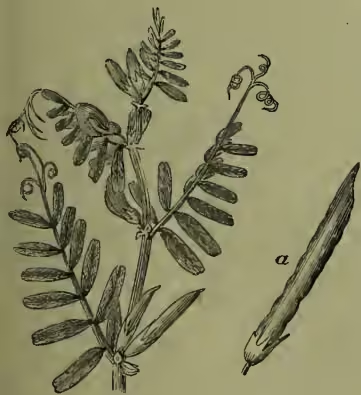
a, seed-pod.
But the first attempt to elevate the art into a science occurred in 1761, when France set the example of establishing the first veterinary college under royal patronage at Lyons, the first professor being Bourgelat, who wrote numerous anatomical and medical works bearing on the infant science. Shortly afterwards (1766) a second school was established at Alfort near Paris, to which Bourgelat was transferred. Both of these colleges are still flourishing, and establishments of a similar kind were organised in the capitals of almost every European country, including London. Contemporary with Bourgelat flourished the elder La Fosse, who made numerous discoveries and improvements, usually communicated in the form of memoirs to the Academy of Science in Paris. In 1754 these memoirs were published in one volume, which was quickly translated into other languages. His son proved a worthy successor to the illustrious father, in 1766 publishing his Guide de Maréchal, and in 1772 his greatest work, the Cour d'Hippiatrique; it contains sixty-five anatomical plates coloured after nature, with concise descriptions in letterpress. He afterwards published his Dictionnaire d'Hippiatrique in 4 vols. After the death of Bourgelat and the two La Fosses no great progress was made until after the Revolution, when the names of Hartman, Chabert, Huzard, and others stand prominently forward.
Reverting to the history of the art in Britain, we find that Thomas Blundeville (fl. 1561) was one of our earliest authors. He was succeeded by Mascal, Martin Clifford, and Burdon, and at this time Gervase Markham wrote his well-known but absurd Treatise on Farriery. In the time of Charles II. Snape's Anatomical Treatise on the Horse appeared. In the reign of George I. Solleyse's treatise was translated by Sir William Hope. About the middle of the 18th century appeared the works of Gibson, Bracken, Bartlet, Osmier, Taplin, and others. The majority of these writers were entirely ignorant of the nature of disease; in fact they were men of recipes and infallible cures, having but little knowledge of anatomy, physiology, or the allied sciences, although many of them were members of the medical profession; consequently glanders, farcy, blindness, pole-evil, &c. were rampant. The diseases of cattle were but little studied; hence the loss of animal life was very great. The importance of a more extended knowledge of the art as a science now began to be felt in England, and the Odiham Agricultural Society in 1791 formed the Veterinary College of London, with M. St Bel as professor. St Bel, a Frenchman who had studied under Bourgelat, died in 1793.
The professorship was now accepted by Coleman, a young surgeon, a friend of Sir Astley Cooper, Abernethy, Cline, Babington, and other eminent men. He paid great attention to sanitation and the prevention of diseases. Against the prevailing opinion he recommended fresh air in the treatment of lung diseases, and his ideas on ventilation were soon justified by marked decreases in such diseases as glanders and periodic ophthalmia. Coleman was assisted by a practical veterinarian named Moorcroft, who, however, withdrew and became eminent in India. Great interest was taken in the college and its work by John Hunter, Cooper, and others. Coleman was succeeded by Sewell, who recommended the frog-seton—a useless and barbarous practice—in navicular disease and excision of the nerve in chronic foot lameness. Delabere Blain, Percival, and Youatt were good anatomists, but, like their immediate predecessors and contemporaries, they advocated the heroic method of treatment. In fact the complicated but harmless recipes of past authors were thrown aside, and bleeding, physicking, and blistering were fully brought into operation. Sewell was succeeded by Spooner, who was followed by Simonds. After Sewell the heads have been Simonds, Spooner, Robertson, and Brown. Commencing with one professor in 1791, the college now possesses a staff of about a dozen professors and demonstrators, and, from a possibility of obtaining a diploma in a few months, it is now necessary that every student shall attend three scholastic years and pass first an educational—or provide recognised certificates—and three professional examinations. These conditions also apply to the Scottish colleges, and the students from all the schools are examined by one board of examiners, who are appointed for five years by the Royal College of Veterinary Surgeons.
The Edinburgh Veterinary College was instituted by Professor Dick, born in the White Horse Close, Canongate, and the son of John Dick, blacksmith and farrier. He attended lectures on anatomy and medicine at the university of his native city, and towards the end of 1817 he joined the London Veterinary College under Coleman. In 1819 he commenced to lecture in the Freemasons' Hall, Niddry Street, in connection with Mr Scott; but this proving a failure, Dick commenced an independent course in an unfurnished shop in Nicolson Street, one student only being the regular attendant. In 1823 Dick's efforts were patronised and to some extent supported by the Highland and Agricultural Society of Scotland, the lectures being delivered twice a week in the Calton Convening Rooms, and the attendance of students rapidly increasing. Professor Dick died in 1866, leaving his college in trust to the lord provost and magistrates, who in 1867 appointed the present writer to the principalship. He, however, in 1873 founded the New Veterinary College. In 1861 M'Call founded the Glasgow Veterinary College.
In 1844 the members of the profession holding the diplomas or certificates of the schools only obtained a charter from Her Majesty constituting them a body corporate with power to elect twenty-four members of council, who elect their own president and vice-presidents, and appoint examiners. This council now possesses further powers to regulate the curriculum of the teaching colleges, the subjects of examination, &c.
In the later half of the 19th century veterinary colleges have been founded in the United States, in the principal British colonies, and very recently in India. The first college established in Canada is the Ontario Veterinary College at Toronto; and in 1866 another college was instituted in Montreal, and is now the Faculty of Comparative Medicine and Veterinary Science of the M'Gill University. In Australia colleges have lately been instituted, and in India several schools are now in working order, presided over by army veterinary surgeons. The American Veterinary College at New York was incorporated and organised in 1875. Many of the American universities have created faculties of veterinary medicine, the best known of these being that of Harvard; others are those of Minnesota, Cornell, and Ithaca.
See George Fleming's Veterinary Obstetrics, Operative Surgery, Animal Plagues, and several other works, besides his edition of Chauveau and Arloing's Comparative Anatomy of the Domesticated Animals (1873); the present writer's Veterinary Medicine (10th ed. 1892) and Veterinary Surgery (10th ed. 1892); Finlay Dun's Veterinary Medicines (1873-78); Robertson's Equine Medicines; Smith's Veterinary Hygiene and Veterinary Physiology, &c. There are four periodicals devoted to the subject in Britain. See also, amongst articles in this work, the following:
| Anthrax. | Dog. | Pig. |
| Black Water. | Farcy. | Pleuro-pneumonia. |
| Bots. | Fluke. | Ringbones. |
| Braxy. | Founder. | Spavin. |
| Cattle. | Germ. | Splint. |
| Cattle-plague. | Glanders. | Strangles. |
| Constipation. | Horse. | Ticks. |
| Consumption. | Horseshoeing. | Tubercle. |
| Corns. | Mange. | Warranty. |
| Distemper. | Navicular Disease. | Weed. |