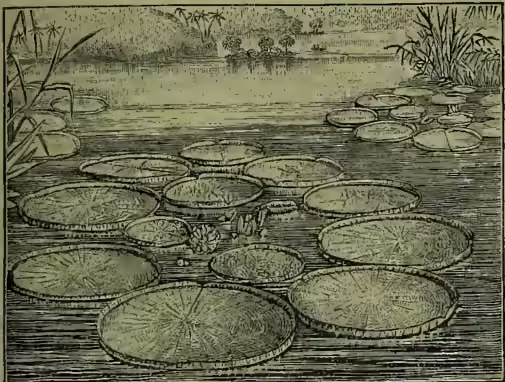
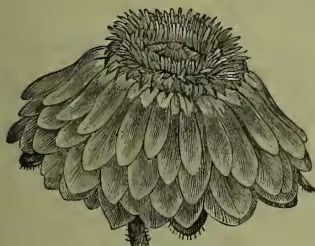
Victoria, a genus of plants of the natural order Nymphaeaceæ, resembling the common water-lily, but most nearly allied to the genus Euryale, and distinguished from it particularly by the deciduous tips of the calyx, and the sterility of the innermost stamens. Only one species is yet known, V. regia. Seen by Hänke about 1801, by Bonpland, D'Orbigny, and others, it was first described in 1832 by Pöppig, who observed it in the river Amazon; and it was found by Schomburgk and others in many rivers of the north-east of South America. Its leaves are peltate, circular in outline, float upon the water, and attain a diameter of 5 to 6 feet; have the margin turned up all round about 2 inches high; are of a purplish colour on the under side, and there exhibit a sort of wicker-work of very prominent veins, furnished with prickles. The flowers rise amongst the leaves upon prickly stalks. They are more than a foot in diameter, white, internally rose-coloured, and are very fragrant. The fruit is a capsule, almost globose, with a depression on the top about half the size of a man's head, fleshy within, and divided into numerous cells, full of round farinaceous seeds, which are an agreeable article of food. The plant is therefore called Maïs del Agua, or Water Maize, in some parts of South America. To the cultivation of this plant special hothouses have been devoted at Kew, Chatsworth, Crystal Palace, and other places in Britain, and elsewhere in Europe, and it was successfully cultivated and flowered in a heated tank in the open air in a nursery at Chelsea in 1851 and a few years subsequently. It has been introduced into India from seeds produced in England.