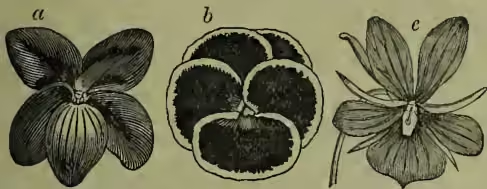
Violet (Viola), a genus of herbaceous plants, mostly perennial, of the natural order Violaceæ. They have a short stem, or are stemless, having in the latter case a short root-stock (rhizome); the leaves are alternate, and have long stalks; the flowers have five petals, different in form and size, the lowest having a spur behind. About 100 species have been described, natives chiefly of northern temperate countries. Several species are much cultivated in gardens, some, as V. tricolor, on account of their beautiful flowers; others, as V. odorata, on account of their fragrance. V. tricolor, the Pansy, Pansy Violet, or Heart's Ease, is very abundant in fields, meadows, woods, &c. in Britain and in most parts of Europe, and the north of Asia; it is also found in North America, although it has probably been introduced there from the Old World. It is a very variable plant, its flowers differing much in size and colour, but is readily distinguished by its large lyrato-pinnatifid stipules. The stem is somewhat triangular, branching, and diffused. In some of its most common forms this plant is a mere despised weed, with small flowers; other wild forms have much larger flowers; and to it are referred the large and beautiful garden pansies, the varieties of which are innumerable. The Pansy (Fr. pensée, probably from the drooping attitude of the flower, suggestive of thoughtfulness) is one of the finest of florists' flowers (see Vol. IV. p. 694), and no flower has been more improved by cultivation. There are two classes or types of pansy, the Show Pansy, in which the colours are either white, yellow, or purple, alone or in combination, and the Fancy, in which crimson or maroon is added to the other colours and the flowers are beautifully blotched or shaded, having a clear margin of the ground colour surrounding them, as shown in No. 2 of the illustration. No. 3 shows one of the original parents of the popular Bedding Violas, the varieties of which are very numerous. By intercrossing with the pansy and other showy species greater variety and brightness of colour prevails now than formerly when purple was the principal tint. Another species has of late years been introduced into cultivation, V. altaica, a native of Siberia, and by itself, or by hybridisation with V. tricolor, has become the parent of many garden pansies. The finest garden pansies are not preserved or propagated without great difficulty, and require most careful cultivation, without which they quickly relapse to their wild forms. Florists demand that a pansy shall have a round, flat, and very smooth edge, the petals thick and velvety, the three front petals alike in their ground colour, the lines or pencillings in the centre bright and distinct, the two back petals—which always differ in colour from the others—perfectly uniform, the flower measuring at least an inch and a half across. The Sweet-scented Violet (V. odorata) is common in grassy places in England and throughout Europe and the north of Asia. The flowers are either of a deep blue colour or more rarely white. Several other species, with pale blue flowers, and destitute of smell, are common in meadows and woody glades in Britain and other parts of Europe. The Dog Violet (V. canina) is one of the most common ornaments of hedgebanks. North America has a number of species, one of which, V. blanda, is sweet scented. The Himalayas produce a number of species very similar to those of Europe. The roots of several species of violets were formerly used in medicine. They contain a bitter alkaloid, Violine, which acts as an emetic and purgative. The petals of the sweet-scented violets are used for the preparation of Juice or Syrup of Violets, which is used as a gentle purgative for children, and also as a chemical test, being reddened by acids, and rendered green by alkalies.
The Dog-tooth Violet (q.v.; Erythronium denscanis) has no connection with this genus, but is a very beautiful flower of the natural order Liliaceæ. —The so-called Violet-powder, used for purposes of the toilet and nursery, is very fine starch perfumed with orris-root or other perfume.