Vision, the act of seeing, that faculty of the mind by means of which, through its appropriate material organ, the Eye (q.v.), we perceive (see also PERCEPTION) the visible appearances of the external world. Vision is mainly concerned with the colour, form, distance, and tridimensional extension of objects. It is caused by impact of ether-waves on the retina of the eye (see EYE); but if these waves be longer or shorter than a certain limit (see COLOUR) there is no visual impression produced by them. The apparent colour of an object depends partly on the wave-length or wavelengths of the incident light-waves, single or mixed, and partly upon the state of the eye itself, as in Colour-blindness (q.v.), or after taking santonine, which makes external objects look yellow, or in jaundice. The apparent brightness of an object depends upon the amplitude of the light-waves which pass from it to the eye; and the smallest perceptible difference of brightness always bears a nearly constant ratio to the full intensity of the bright objects (Fechner's psychophysical law). As between different colours, the eye perceives them with different intensities, even when the physical intensity is the same: thus yellow appears brighter in a bright light than an equally intense red: and as light fades away the different colours fade away unequally, so that the ratio in Fechner's law above referred to is different for each colour: red and yellow disappear first, blue last; and thus in a dim light the blue is the brightest.
The leading problems in the theory of vision are, however, those which deal with the nature of our perception of distance and of three-dimensional extension. According to Bishop Berkeley, whose views (On the Theory of Vision) have met with the widest acceptance, we do not by means of sight perceive either that external objects are outside ourselves or their distance from us; but this knowledge is derived from touch and from our experience of motion from place to place; and as our experience is in general uniform, we come to associate the visible with the tangible so readily that we fancy we directly see visible objects. As regards the distance of any given point, Bishop Berkeley maintains that this cannot be seen, 'for distance being a line directed end-wise to the eye, it projects only one point in the fund of the eye; which point remains invariably the same, whether the distance be longer or shorter.' This may be true, and yet the eye may be obliged to put forth perceptibly different efforts in order to discriminate points situated at different distances. Rays proceeding from the distant point form a cone, whose base is the pupil of the eye; and in order to make this divergent cone converge on a point in the retina a distinct effort of focussing or accommodation is necessary for each distance. That the distance may be judged by means of the necessary effort of accommodation may be seen by taking a small thin-edged lens, holding it at arm's length, and viewing distant objects through it. A small inverted image of the distant objects is seen; but on trying to ascertain at what distance this image is situated, the necessary accommodation teaches us that it is situated between the eye and the lens. The effort of accommodation appropriate to each distance is the same whether the rays have actually come from the apparent distant point or not, so long as they approach at a certain angle of divergence: hence rays from clouds reflected in still, turbid water, and continuing their divergence after reflection, approach the eye, and are dealt with by it, as if they had proceeded from a great depth below the surface of the water. Similarly the apparent depth of objects under water is diminished because the amount of divergence of the rays is altered by refraction; and the apparent distance of an object is increased by repeated reflection because after such repeated reflection the rays originally diverging from the object reach the eye diverging as if they had come from a more distant point, the virtual apex of the incomplete cone of ultimately reflected rays.
The axis of the double cone of rays, first divergent as it approaches the eye, and then convergent upon the retina within the eye, fixes the direction of the apparent position of the point (which may or may not be the real position, according to circumstances), and the strain to which the eye is subjected in accommodation measures the apparent distance in that direction.
Further, we have not only to do with the effort of accommodation, but also with the varying amount of convergence of the two eyes, or of their 'optic axes,' required in order to fasten the gaze upon a more or less distant point; and this will be found to keep pace with the amount of accommodation required by each eye in order to ensure accurate focussing on the retina.
According to the Berkeleian view, however, these considerations involve geometrical questions the nature of which is known to few and is not consciously realised. But, on the contrary, it may be said that these operations of the eye being different for each distance of the object, and being felt to be so—as, for instance, where we look out through a window and feel that the sensation of looking out through the window is different from that of concentrating the gaze upon the window-bars—there is no need for the geometrical discussion of the problem; the facts of sensation are sufficient. Berkeley said that this difference of sensation does not come into play until the increased divergency becomes so great as to be associated with confused vision; and he maintained that this association was merely accidental, as was, in his view, shown by certain experiments with lenses, in which the withdrawal of the eye from a convex lens produced an apparent approach of the object looked at. This experiment was, however, shown by Wheatstone to be entirely explicable on the basis of an enlarged retinal image. Still the illusions produced by virtual images of objects, the rays reaching the eye as if they had come from points to which no physical reality corresponds, show that we rely in general upon the evidence of the sensations of adjustment which accompany vision for the materials as to our judgment of direction, of distance, and of externality; but we interpret these through our tactile experience. In the case of smoke and vapour, which are not tangible, we have a certain amount of experience as to the space and position occupied by them; and in the case of such an object as perfectly polished glass, which is invisible or practically so, we are left to the sense-fallacy that where the sight affords us no information, owing to the absence of any light-rays entering the eye from the object, the inference is drawn, as the basis of previous experience, that there is no tangible object to be taken into consideration. Similarly, with objects too minute for touch, we interpret the indications of sight—e.g. those arrived at with the aid of a microscope—as showing, by analogy, that if we could apply a sufficiently refined sense of touch we would feel the object to give rise to sensations corresponding to its external aspect. The two sets of sensations, visual and tactile, are essentially independent of one another; but the distance of an object and its external form in three dimensions are learned by comparing the sensations of touch, in the widest sense, with the sensations accompanying vision while the object is still beyond reach; and the experience acquired in infancy becomes a possession of the adult philosopher who has forgotten the mental processes by which he attained it. A mountain in a clear atmosphere, say in Colorado, may appear to a British eye to be small and near, when in reality it is high and far; but it does not take long to ‘educate the eye’—that is, to furnish the mind with a store of experience sufficient as a basis for more accurate inferences.
On ordinary optical principles a point above the direct line of vision comes to a focus at a point of the retina below its centre, and vice versa. If the retina could be looked at by another person it would be found that an image of the object is formed on the retina, and that this image is inverted. It has been much questioned how this inverted image can produce the sensation of direct vision. We may observe in the first place that the question is somewhat nugatory, since the individual never becomes directly aware of the inversion or, it may be, even of the existence of the physical image in his own retina; and secondly, that the individual has come strongly to associate, by experience, the top of an object with the act of looking up in order to see it, and vice versa. Any increase in the magnitude of the retinal image is generally associated with approach of the object, and in the exceptional cases in which this result can be brought about by means of lenses, even where the real distance is increased, the object seems to approach; this seeming to approach being the result of an unconscious process of reasoning. The mind, on the basis of tactile experience, interprets any given object as being of a known or ascertained size: if it comes to look larger, it is inferred that it has come nearer.
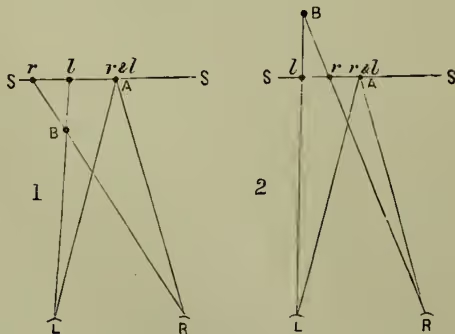
As to single vision with two eyes, the figure shows that if L and R represent the two eyes and SS a line (the ‘horopter’) drawn through the point A where the optic axes LA and RA intersect, and parallel to a line joining the two eyes L and R, the point A is seen in corresponding points of the two eyes, axially situated; but two points r and l may be so placed, either in the plane of the horopter or outside it, that the two eyes together perceive them as one point B. This point is in fig. 1 nearer to the eye and in fig. 2 farther from the eye than the horopter SS itself. If now, in fig. 1, a diagram be made representing l and A and another representing r and A; and if the former be laid before the left eye and the latter before the right eye, the two optic axes being made to converge so that the image of A is formed in corresponding points in the two eyes, the points l and r will appear to blend into one, situated nearer the eye than A or farther from it; and this explains the action of the stereoscope, and also the ‘pseudoscopic’ effect produced when the pictures are reversed (see STEREOSCOPE). The impression of relief is thus produced by rays falling on non-corresponding points of the retina. If the retinal pictures are identical, the optic axes being convergent, the image is seen in the plane of the horopter: thus if a small-patterned wall-paper be looked at and then the eyes made to squint slightly, the wall-paper will appear to approach, for the horopter (SS, figs. 1 and 2) is now nearer to the eye, and vice versa. Professor S. P. Langley estimates that the amount of Energy which is necessary, in the form of incident Light, to produce vision ranges from 1000 erg (= 1.13562,700,000th foot-pound) for the extreme red to 10000000000 erg for the green of the spectrum.
The subject of vision is a very large one, and the reader may be referred to Von Helmholtz’s Physiological Optics, part iii. (German or French editions), which contains copious bibliographical references; and also to Berkeley’s Theory of Vision; Wheatstone, On the Physiology of Vision; Samuel Bailey’s Review of Berkeley’s Theory of Vision, and a review of this work by J. S. Mill, Dissertations and Discussions; T. K. Abbott’s Sight and Touch; Von Helmholtz’s Popular Lectures; and Sully ‘On Vision,’ Mind, Nos. ix. and x.