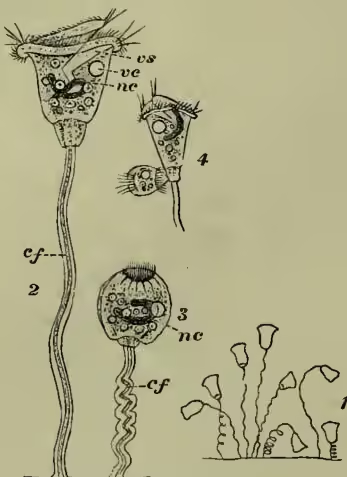
Vorticella, or BELL-ANIMALCULE, a genus of ciliated Infusorians belonging to the order Peritrichia, in which the cilia are restricted to a fringe around the mouth. During most of their life the little animals are attached to the stems and leaves of plants in fresh-water pools, a group being just visible to the unaided eye as a whitish fringe. Each is a bell-shaped unit borne on a hollow stalk containing a contractile filament, whose activity causes the stalk to change frequently and instantaneously from a state of complete extension to a state of spiral contraction. Around the mouth of the bell there is a spiral fringe of cilia, which, by their lashing activity, waft food-particles into the mouth. A vorticella often reproduces by division, one of the halves being set adrift, furnished with a posterior circket of cilia. Or it may be that after division into two one of the halves, still undetached, divides rapidly into eight small units, 1, general appearance of a group, magnified; 2, single individual fully extended; 3, the same with spirally contracted stalk; 4, liberation of half of a divided unit; ne, nucleus; vs, mouth; ve, vacuole; cf, contractile filament of stalk. Nos. 2, 3, 4, highly magnified. which, becoming separate, swim off (also with posterior cilia), and conjugate with sedentary individuals of normal size. There is here one of the early hints of sexual dimorphism.