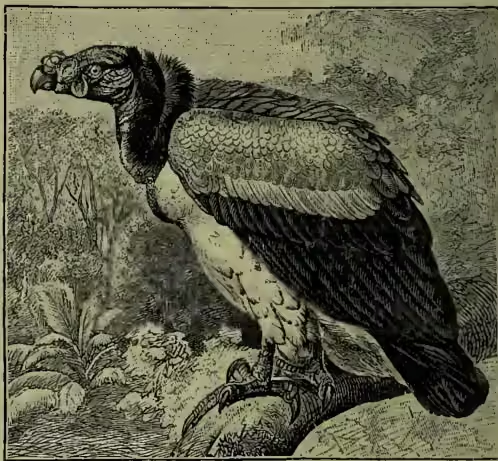
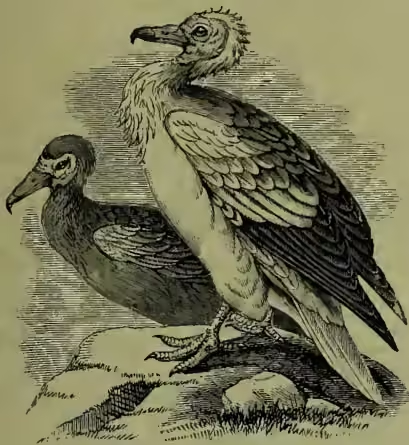
Vulture, any member of the family Vulturidae included among the Birds of Prey in the sub-order Falcones. By some naturalists the family is subdivided into the Old-World vultures (Vulturinae) and the New-World vultures (Sarcorhamphinae), while by others the latter, which are distinguished by a perforated nostril and the absence of an 'after-shaft' to the feathers, are regarded as a distinct family, Cathartidae. In all the vultures the head and neck are more or less bare, the beak is long and curved only at the tip; the legs and feet are large and powerful, but the toes and claws are relatively weak. They are thus well adapted for walking and feeding on the ground, but are unable to carry off their prey like the eagles and hawks. The wings are very strong, and their powers of swift and sustained flight are remarkable. Vultures are widely distributed throughout temperate and tropical regions, and the general habits of the various species are very similar, though they differ greatly in their choice of haunts. Thus one species frequents the rocky peaks of the Alps and another sweeps over the great plains of Africa; the King Vulture dwells alone with his mate in the densest parts of the South American forests, while Pharaoh's Chickens pick up a living as street scavengers in the towns of the East. The chief food of the vultures is carrion; they rarely attack any living animal unless under great stress of hunger, when a wounded or feeble lamb or hare is sometimes killed. There has been much discussion as to whether vultures scent or sight their prey, but experiment has shown, apparently conclusively, that their sense of smell is not unusually acute, and that they rely chiefly on their extreme keenness of vision, while the sudden descent of one bird serves as a signal to many others. When a carcass is discovered by one, others arrive quickly on the scene from all points of the compass, though none may have been visible a few minutes before. Tearing off the skin with their powerful beaks they gorge themselves greedily on the flesh and entrails till nothing is left but the skull and larger bones. Smaller birds only venture to look on and watch for stray morsels which may be let fall, but in the neighbourhood of towns the vulture's claim is sometimes—not often successfully—disputed by wandering dogs. After a full meal vultures may remain without food for many days. The young birds, which are carefully tended for several months, are fed by regurgitation of food from the crop of the parents. One of the commonest European species is the Griffin Vulture (Gyps fulvus), which occurs in Spain, among the Alps, and in the Mediterranean region generally. It makes a rough nest of branches and grasses, usually in a cavity or on a ledge of an almost inaccessible cliff. One or at most two eggs are laid early in March, and the parents share the labour of rearing and tending the young. The adult bird measures feet in length; the general colour is light brown with black markings, and there is a white ruff on the lower part of the neck. The Eared Vulture (Otogyps auricularis), an inhabitant of Africa, receives its name from folds of skin on the head resembling ear-lappets. The Egyptian Vulture (Neophron percnopterus) is often called Pharaoh's Chicken from its frequent occurrence in ancient Egyptian hieroglyphics, where it is used as an emblem of parental love. It is very common throughout northern Africa and Persia, and breeds frequently in the south of Europe. More than one specimen has been killed in England. The Egyptian vulture is raven-like in form; its wings are pointed, its bill slender, and half covered with a naked cere. The adult bird is little over 2 feet in length; its plumage is white with black wing-feathers. The young birds are dark brown. Some account of the New-World vultures will be found in the article CONDOR.