Wagtail, a family (Motacillidæ) and a genus (Motacilla) of Passerine birds. The family, which includes the true wagtails and the Pipits (q.v.), is distinguished from the thrushes, warblers, crows, shrikes, waxwings, and starlings by the absence of the bastard or first primary; from the finches by the slenderness of the bill; from the swallows by the slenderness of the bill and the greater length of the legs; and from the larks, probably its nearest allies, by having the tarsus scutellated only in front, and having an additional spring moulting, which, however, does not extend to the quills and tail-feathers. In distribution it is almost cosmopolitan, being absent only from the Polynesian subregion. It is most abundantly represented in the Palearctic, Ethiopian, and
Oriental regions; least so in the Nearctic, only one species of wagtail entering the New World, but pipits being more represented.
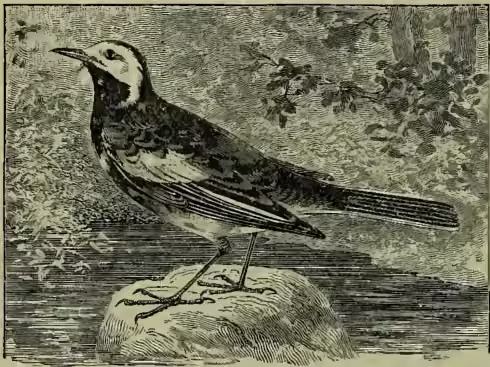
The genus Motacilla, the true wagtails, includes about thirty species, of which eight are European and five British. They frequent open and well-cultivated districts, where they are found on banks of streams and ponds and in pastures. They are almost exclusively terrestrial in habits, and run gracefully and swiftly along the ground, constantly jerking the long tail up and down. Their flight is very undulatory; they have little power of song. Their food consists of insects and small shellfish. Their nests are built in holes in rocks or on the ground. The Pied Wagtail (M. yarrelli or lugurris) is from 7 to 8 inches long, and has beautifully-marked white and black plumage. It is found all over the western part of Europe, and is generally distributed as a resident throughout the British Islands, visiting and nesting in the extreme north of Scotland and, sparingly however, in the Hebrides and Orkneys, and known in the Shetlands and St Kilda on its spring and autumn migrations. Although a British resident bird it is partially migratory, especially in the northern districts; even in England there is a general movement northwards in spring and southwards in autumn. It breeds in April, the nest being made of moss, dry grass and roots, and placed in a hole in a bank, wall, rock, tree, or even in an open field. The cuckoo often selects this nest in which to lay her egg. The young differs considerably from the old bird in plumage. This species was long confounded with the White Wagtail (M. alba), found over the whole of Europe, northern Asia, India, Burma, and North Africa, occurring not uncommonly in England, more rarely in Scotland, and very rarely in Ireland. In general habits, food, and haunts it closely resembles the pied wagtail, but it has been known to breed in the burrow of a sand-martin. The Gray Wagtail (M. melanope or boarula), the Yellow Wagtail (M. rayi), and the Blue-headed Wagtail (M. flava) are the other British species. A variety of this last occurring in Alaska is the only true wagtail found in the New World. Cuvier classed wagtails with yellow coloration in a genus Budytes; and for the gray wagtail Kaup established the genus Calobates.