Walnut (Juglans), a genus comprising seven or eight species of beautiful trees of the natural order Juglandaceæ. All are trees with alternate pinnated leaves, monœcious flowers, and a drupe-like fruit, with a deciduous fleshy husk, which bursts irregularly, and a deeply wrinkled shell (putamen) of two valves, within which is the seed, curiously lobed and wrinkled, with a membranaceous testa and partial dissepiments. The Common Walnut (J. regia) is a native of Persia and the Himalayas, but has long been cultivated in all parts of the south of Europe.
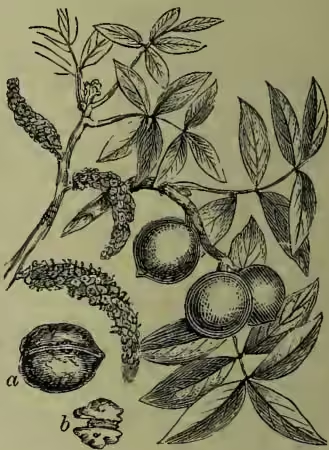
a, nut; b, seed.
The date of its introduction is unknown, but it was certainly cultivated by the Romans in the reign of Tiberius. It is a lofty tree of 60 to 90 feet, with large spreading branches. The leaves have two to four pairs of leaflets, and a terminal one. They have a fine balsamic odour when bruised; this quality, however, being much more marked in some trees than in others. An infusion of them has been found useful in scrofula; when bruised and rubbed on the skin they are efficacious in curing itch; and placed in wardrobes they prevent the ravages of moths. The sap is limpid like water, but contains much sugar, so that the tree is sometimes tapped for it, like the sugar-maple, and the sugar is procured by evaporation; a pleasant kind of wine is also made from it. An excellent pickle and a kind of ketchup are made of the unripe fruit. The ripe fruit is one of the best of nuts, and is an important article of export from many parts of the south of Europe. Walnuts are also exported in large quantities from Casimere and other Himalayan regions to supply the markets of India. In the south of Europe walnuts are a very considerable article of food, and when perfectly fresh they are wholesome and nutritious, although in the state in which they are imported into Britain they are not easily digestible. Just before they are ripe they are much used in France with vinegar, salt, pepper, and shallots. Among the varieties of walnut in cultivation is one with a very thin shell, which is much esteemed. Walnuts yield by expression a bland fixed oil, which, under the names of Walnut Oil and Nut Oil, is much used by painters as a drying oil, and in the countries in which it is produced is a common article of food. The cake left after the expression of the oil is sometimes used as an article of food, and is also used for feeding cattle and poultry. The timber of the walnut is of great value, and is much used by cabinet-makers. It is light, although hard and fine-grained; and gun-stocks are made of it. The wood of young trees is white, and little esteemed; that of old trees is brown, veined and shaded with darker brown and black. Aged trees of fine quality have been sold for £600 each. The wood of the roots is beautifully veined. Both the root and the husks of the walnut yield a dye, which is used for staining light-coloured woods brown. The walnut, when meant to become a timber-tree, is best sown where it is to remain, as the roots are much injured by transplanting. The best kinds of walnut for fruit are generally grafted. The walnut succeeds well in Britain as an ornamental tree, even in the north of Scotland, although it seldom quite ripens its fruit except in the warmest parts of England. The names in Teutonic lands (A.S. wealh-lmutu; cf. Ger. walnuss) indicate that it came into north Europe from Italy and France. Very similar to the common walnut is the Black Walnut (J. nigra) of North America, found in most parts of the United States, except the most northern. It is a very large and beautiful tree, the trunk sometimes 6 or 7 feet in diameter; its leaves have more numerous leaflets than those of the common walnut. The timber is even more valuable than that of the common walnut; the fruit is very inferior. The Butternut (J. cinerea) is abundant in the northern and north-western states of North America, and in Canada. It is a tree only about 50 feet high, with trunk about a foot in diameter; leaves with fifteen to seventeen leaflets; the fruit elongated, and externally covered with a viscid substance. The nut is hard and rough, with prominent ridges, and of good quality. The wood is not apt to split or warp, and is useful for many purposes. Sugar is obtained from the sap, as from that of the maple, but is of inferior quality. The inner bark is a mild cathartic, resembling rhubarb in its properties. The leaves, reduced to powder, are used for blistering, like cantharides.