Walrus, or MORSE (Trichechus), a genus of aquatic, web-footed (pinniped) Carnivores, sole living representative of a family (Trichechidae) in many ways intermediate between the sea-lions and the seals. Two genera of huge extinct forms—Trichechodon and Alactherium—are also referred to the same family. The walrus resembles the seal in the absence of external ears, and the sea-lion in the way in which the hind feet are turned forward and used in hobbling along, but is at once distinguishable by the development of the upper canines into enormous tusks. Two species are distinguished—T. rosmarus in the Arctic seas, T. obesus in the North Pacific—but the two are closely alike.
A full-grown animal measures from 10 to 12 feet in length, and there is force in the old description which pictured the huge creature as 'large as an ox and thick as a hogshead.'
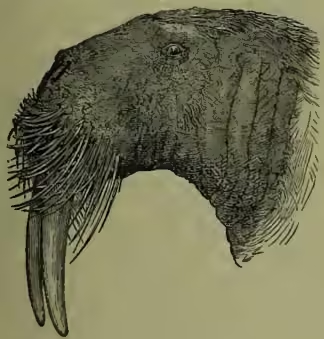
The head is relatively small; the eyes, fierce to look at, are small; external ears are absent; the muzzle, with swollen upper lips, bears stiff whiskers, each hair as thick as a crow quill; the shoulder region is strong and massive; the short tail is hidden by a flap of skin which unites the hind legs; the limbs are webbed flippers with minute nails on all the digits except the three middle toes of the hind foot, where they are large and strong; the soles are bare and roughly furrowed; the hair is short, and varies in colour from light yellow above to chestnut brown below; the thick loose skin tends to become bare as the animal grows older, and is often much wrinkled and scarred. The dentition of the young is expressed in the formula , but many of the teeth are lost or remain rudimentary, and the adult has only . The tusks or upper canines are sometimes 2 feet long; they do not become conspicuous until the animal is about two years of age.
Walruses live near the coasts among the Arctic ice, often on floating packs. They are gregarious in habit, posting sentinels, and aiding one another with all their strength against the attacks of men or polar bears—practically their only enemies. Apart from the fierce contests between rival males at pairing time, they are peaceful animals, but when molested or robbed of their young display much ferocity. In their sexual relations they are said to be monogamous; the young are born, after a gestation of about a twelvemonth, between the months of April and June, and normally there is but one at each birth. As the pathetic tales of the walrus-hunters amply testify, the females tend their offspring with solicitude, and will fight for them to the death, while the young during the prolonged period of suckling—lasting for one or two years—are tenaciously affectionate to their mothers. Walruses feed chiefly on bivalves, especially Mya truncata and Saxicava rugosa, which they dig up with their tusks, crush with their tongue and back teeth, and so sift that only the soft parts are swallowed. Besides bivalves, they also eat crustaceans, star-fishes, sea-urchins, worms, and the like, and have a strange habit of swallowing pebbles. Seaweeds have also been found in their stomachs, but this is probably the result of accident, and not indicative of a partially vegetarian diet. The young walrus kept for a time at the Zoo in London was not particularly discriminating in its diet, but showed no inclination for Algæ. The tusks are chiefly used in grubbing for food, but they are also formidable weapons, and according to the majority of observers they also serve to break breathing-holes in the ice, and to help the animals, which are as awkward out of water as they are agile in it, to climb among the rocks and ice. In the autumn the walruses have a period of fasting, the precise nature of which is not clearly known. The voice of the walrus is a roaring bark, 'between the mooing of a cow and the deep baying of a mastiff.'
Mainly as the result of ruthless destruction, the range of the walrus has been greatly narrowed, for they are no longer found so far south as they once were, and in many parts of the Arctic regions where they were once abundant they are now scarce. This is not to be wondered at, as there are records of hunts during which as many as a thousand walruses were captured. Sometimes they are surprised on land, and then they fall easy victims to the hunter; usually, however, they are attacked in the water by harpooning-boats, and this is often full of hazard. The oil of the walrus is used like that of seals; the hide is made into harness, ropes, and fishing-lines; the ivory tusks form weapons, utensils, and ornaments, and the flesh is eaten by the Eskimos and Tchukchis. The word walrus is Norwegian (hval-ros, whale-horse), and another Norwegian name, rosmar, has been translated into one of the common English titles, sea-horse. The name morse is from the Russian morsk or Lapp morsk. The Eskimos and Greenlanders call the creature Awük from its cry.