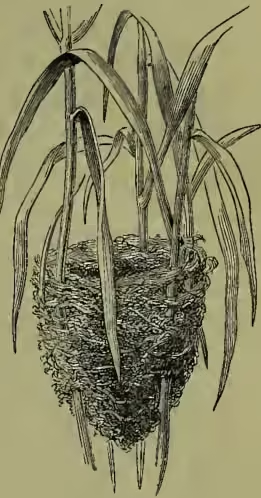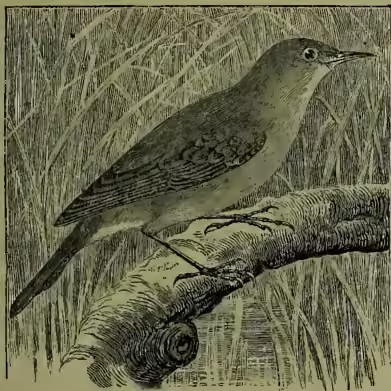
Warbler, a popular name often applied to all the birds of the family Sylviidæ (q.v.; sometimes called by the French name of Fanvettes), many of which, however, commonly receive other popular names, as the Blackcap, Nightingale, Hedge-sparrow, Redbreast, Redstart, Stonechat, Wheat-eat, Whitethroat, &c. (q.v.), while many receive the name Warbler with some adjunct—Reed-warbler, &c. The more typical genera comprise birds of small size and plain plumage, usually alike in both sexes; most of them are migratory, going a long way south of their breeding-haunts to winter; for instance, the Siberian Chiff-chaff (Phylloscopus tristis) winters in India. Such genera are Sylvia, to which the Blackcap and Garden-warbler belong; Locustella, of which is the Grasshopper-warbler (L. naevia), not unfrequent in many parts of England, and found also in the south of Scotland and in Ireland. It is found in most parts of the centre and south of Europe, at least during summer, being a bird of passage. It is of a greenish-brown colour, the centres of the feathers dark brown, producing a spotted appearance; the lower parts pale brown. It is a shy bird, hiding itself in hedges and bushes, but very active, often darting out like a mouse from the bottom of the hedge, and receives its name from its chirping, grasshopper-like note. The genus Acrocephalus has, like the foregoing, a rounded tail; the species frequent watery places, and are known as Reed-warblers. Some of them nearly equal a thrush in size. The Sedge-warbler (A. schoenobanus) is the most common British species, and is generally found in thick patches of reeds or willows in marshes, or in other situations close to water, and where the aquatic herbage is thick and strong. It abounds on the marshy banks of the Thames. The Reed-warbler (A. streperus) is found in summer in marshy situations in the south of England; it abounds in Holland and in many parts of Europe, and its range extends to the north of India. It is of a uniform pale brown, with a tinge of chestnut; the chin and throat white; the under parts pale buff colour. Its nest is remarkable; it is attached to the stems of three or four reeds, and formed by winding grass or the branches of reed panicles together with a little wool, and is conical and deep, so that the eggs or young may not be thrown out when the reeds are shaken by the wind. The Phylloscopi feed chiefly on small insects and larvae which infest the foliage of trees; they are small species, and in colour vary above from olive-green to brown, and below from yellow or greenish yellow to white. They build semi-domed nests. The Chiff-chaff (P. collybita), so named from its two-noted cry, is a familiar early migrant to Britain. The Wood-warbler, also known as Wood-wren (P. sibilatrix), is common in the wooded districts of England in summer, particularly in old plantations of oak and beech. The Willow-warbler (P. trochilus) is very common in the south of England in summer, but more rare in northern parts of Britain. It frequents woods, shrubberies, thick hedgerows, and bushes, but builds its nest on the ground. Numerous species of warblers are found in North America, but these belong to a quite distinct family (Mniotiltidæ) which appear to graduate into the Tanagers (q.v.). They are birds of brighter plumage than the Old-World warblers, but resemble them in their habits, and are also migrants. Not a few of the species are therefore reckoned among the birds of the West Indies, just as some of the European species are found in Africa. Asia has many species of warblers, among which some of the European species are included. Australia has many species of warblers, some of which (Malurus) are of very beautiful plumage, but these are sometimes made a distinct family (Malridæ). See Howard Saunders, Manual of British Birds.