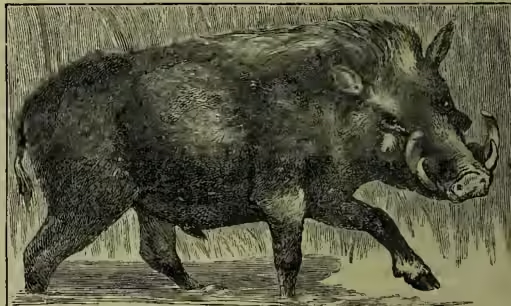
Wart-hog (Phacochoerus), a genus of Suidae, closely resembling the true hogs in most of their characters, and particularly in their feet, but remarkably differing from them in their dentition: the number of teeth is much reduced; the canines become the large tusks, and in the adult the last molar only is found in each jaw, which grows to an enormous size as in the elephant. The head is very large, and the muzzle very broad; the cheeks are furnished with large wart-like excrescences, so that the appearance is altogether very remarkable and uncouth. The species are all natives of Africa. They feed very much on the roots of plants, which they dig up by means of their enormous tusks. The African Wart-hog, or Haruja (P. aliam), a native of Abyssinia and of the central regions of Africa, from the coast of Guinea to that of Mozambique, is nearly 4 feet long, with a naked slender tail of 1 foot, is scantily covered with long bristles of a light-brown colour, and has a mane sometimes 10 inches long, extending from between the ears along the neck and back. Another species is found in the south of Africa (P. aethiopicus), the Valke Vark of the Dutch colonists at the Cape of Good Hope. The incisors of the latter fall out at an early age, those of the former are persistent. A closely allied genus is Potamochærus, of which there are several species, as the Bosch Vark of Cape Colony (P. africanus), which is nearly black, with whitish cheeks having a central black spot, and the Painted Pig of West Africa (P. penicillatus), which is reddish, with black face, forehead, and ears; another and less known species is P. edwardsi from Madagascar. The species of Potamochærus frequent swampy grounds, and sometimes receive the name of Water-hog. They have longer ears than the true wart-hogs, tapering and ending in a pencil of hairs; the face is elongated, and has a huge protuberance on each side. The flesh of all the wart-hogs and water-hogs is in high esteem. They are hunted by dogs, which are often killed in the encounter with them. They are much addicted to fighting among themselves. This genus differs from Sus in that there are only four young in a litter, and that one molar tooth in each jaw has disappeared.