Washington City, the capital of the United States, is situated in the District of Columbia (q.v.), on the Potomac River, in Copyright 1892 in U.S. by J. B. Lippincott Company. 38° 53' lat., 77° 2' long., distant 226 miles S. from New York, 136 from Philadelphia, and 40 from Baltimore. The city covers an area of about 10 sq. m., or, with its suburbs of Georgetown (now West Washington) and the country portion of the district, 70 sq. m. Out of the 6111 acres covered by the city proper the streets and avenues occupy 2554 acres, and the government reservations (parks, &c.) 541 acres, thus leaving more than half its area permanently free from the encroachment of buildings. Besides the numerous small parks, Washington has a zoological park of 140 acres, and the Rock Creek Park of over 1500 acres, purchased in 1892 for $1,200,000, and extending for miles along the picturesque banks of a stream, amid forests of great natural beauty. There are 170 miles of paved streets and avenues, and 65 miles of improved streets: The improved streets are chiefly paved with asphalt, and all are thickly planted with shade-trees, numbering over 85,000, of many varieties, maples predominating.
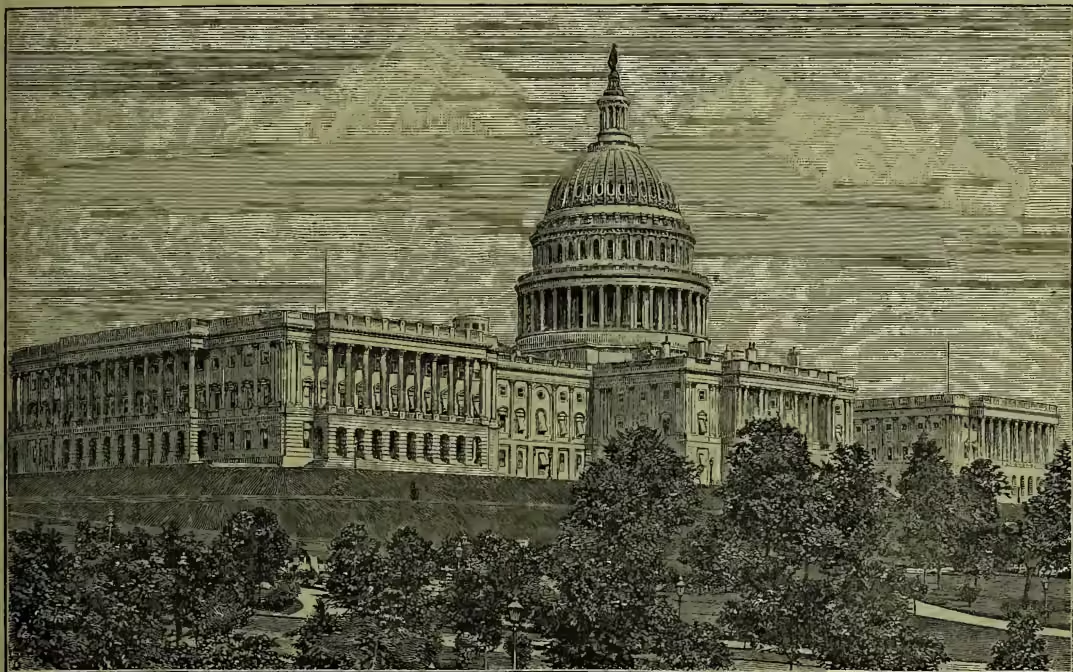
The architecture of the city in the older settled districts is cheap and commonplace, but in the newer Washington is of striking variety and attractiveness. The government buildings are mostly fine and imposing structures. The Capitol, in which the national congress meets and the supreme court holds its sittings, is conspicuously placed on an eminence, commanding a noble view. Its lofty iron dome, crowned by a brouze figure of Liberty, is 285 feet in height, its length 751 feet, and its total cost about 14,000,000, including repairs. The central rotunda contains some elaborate frescoes, and historical paintings by Trumbull (q.v.) and other artists. The hall of the House of Representatives is a spacious apartment, with desks for 356 members, and seats in the galleries for 1500 spectators. The Senate Chamber, with eighty-eight senators, accommodates 1000 spectators. The National Memorial Hall in the Capitol is to receive statues contributed by each state to commemorate two of its distinguished citizens. The Treasury Department at Pennsylvania Avenue and Fifteenth Street, built of freestone and granite in the Ionic style, cost 7,000,000. The Interior Department, in which is located the Patent Office, occupies an entire square in the heart of the city, and is constructed of white marble, in pure Doric, costing 3,000,000. The Post-office Department opposite is a fine marble edifice of the Corinthian order of architecture. The granite building erected for the departments of state, war, and navy, in Renaissance style, is the largest public edifice in Washington, covers <math>4\frac{1}{2}</math> acres, has 566 rooms, and cost 11,000,000. The new Congressional Library building, on Capitol Hill, is built of solid white granite, in Italian Renaissance style, with iron, marble, and brick interior, and will cost 6,000,000. The president's house, and executive mansion, is a plain edifice of freestone, in classic style, painted white (whence called 'the White House'). The other public buildings embrace the Agricultural Department, the Department of Justice, the Pension Office, the National Museum, the Bureau of Engraving and Printing, the Army Medical Museum, the Coast Survey buildings, and the Smithsonian Institution. All of these are of brick, except the last, which is built of red sandstone, in the Byzantine style, with picturesque towers. The national monument to Washington is a towering obelisk of white marble, 555 feet in height, on the bank of the Potomac, erected at a cost of 1,230,000. The United States Naval Observatory, also of white marble, occupies a retired and commanding site on Georgetown Heights.
The National Soldiers' Home, 2 miles above the city, founded in 1851, has 600 acres of improved park and forest, and serves as a free driving park and attractive rural resort, besides its primary function of providing a comfortable home for old and invalid soldiers of the United States army. The National Asylum for the Insane, on the heights above the Anacostia, or eastern branch of the Potomac, has nearly 1000 inmates, who must be either of the army or navy, or residents of the
District of Columbia. There are five hospitals, five orphan asylums, a foundling hospital, and several homes for the aged, for widows, and for the indigent. Washington is rich in institutions of learning, and its free public museums, libraries, and art galleries afford invaluable aids to those pursuing academic or professional studies. The Columbian University, founded in 1814, Georgetown College (Roman Catholic), dating from 1789, the National University, and Howard University (for coloured students) have each departments of law and medicine, besides the regular college course. The Catholic University of America, established in 1887, has two fine stone buildings just outside the city limits, the Divinity College being fully organised, and the Hall of Philosophy soon to be opened. The American University, under charge of the Methodists, has its grounds above Georgetown, and is expected to raise 10,000,000 for buildings and endowment. The National Deaf-Mute College, founded in 1864, is a government institution for the education of deaf and dumb pupils from the army, the navy, and the District of Columbia. Its fine stone buildings lie just north of the city. Gonzaga College (Catholic) is on I Street. There are three business colleges, several seminaries for young ladies, five classical schools, schools of languages, elocution, &c., and a large number of private schools. The public school system is in a high state of efficiency, 35,764 pupils being enrolled in the common schools out of a school census of 52,590. There are 97 public school houses, with 680 teachers, and annual expenditure of about 950,000. The Smithsonian Institution (q.v.), founded in 1846, affords valuable advantages to all institutions of learning, in the United States and abroad, through its system of international exchanges and by its numerous publications of the fruits of original research in many departments of science. The National Museum, originally established to exhibit the rich contributions given to the government by various countries from the World's Fair at Philadelphia in 1876, has become a most extensive and instructive collection of antiquities, ethnology, geology, and natural history generally.
Of bronze statues erected in honour of famous men Washington has an abundance—mainly to military characters. Already hardly a public square or circle is without its monument. Equestrian statues of Washington, Jackson, Greene, Scott, Thomas, and McPherson are erected, besides full-length statues of Lafayette, Luther, Franklin, Chief-justice Marshall, Lincoln, Garfield, Professor
Henry, Farragut, General Rawlins, and Admiral Dupont. Washington has no less than 182 churches. The city is abundantly supplied with pure water, by a conduit 15 miles long, from the Great Falls of the Potomac.
While Washington has few manufactures, no foreign commerce, and but little shipping (being dependent on Georgetown for its small harbour facilities), it has a distinction, as the seat of the general government, to which no other city in the Union can lay claim. The annual assemblage of congress attracts a large influx of visitors from all parts of the country, while the great and far-reaching business of all departments of the government requires a small army of officers and clerks for its transaction. The various bureaus employ between 6000 and 7000 persons. The city is to a great degree populated by the official class, and by merchants, artificers, and small manufacturers who supply their wants. The number of hotels and boarding-houses is very great. A steadily increasing number of people of wealth and taste are building residences at the national capital, where the presence of the diplomatic corps and of travellers and sojourners from all parts of the globe renders the society in a large sense cosmopolitan. The absence of smoky manufactories, the genial and salubrious climate, the pleasant situation and attractive suburbs, with the wide and smooth streets, contribute to render a residence in Washington during most of the year agreeable. The summer brings torrid heats, as in most cities and large towns, though not always long continued. The average temperature of the winter is 36°, spring 55°, summer 76°, and autumn 56°; for the whole year the mean is 56° F.
The government of the Federal city (as President Washington called it, until the commissioners gave it his name in 1791) has been since 1874 vested in a commission of three officers, appointed by the president and senate. They have charge of all municipal and administrative affairs, police, street-improvements, schools, &c., while congress is the sole legislature of the city and district, the citizens having no suffrage. As the government owns nearly half the property in the district, and the city exists largely for the benefit of its officers—legislative, executive, and judicial—it has been settled by act of congress that the government pays half the annual expenses of the city government, the other moiety being taxed upon the property of the citizens. This government by commission has on the whole worked well in practice. The final location of the national capital at Washington, to which it was removed from Philadelphia in 1800, was the fruit of a compromise, after a long struggle between the advocates of various cities in congress. The votes of those who favoured a wholly new settlement for that body, to avoid what were feared as local and sectional influences of the great cities, joined to the advocates of assumption of the state debts by the nation, carried the day for a location in what was then a wilderness. Various attempts were made, owing to the early discomforts of the capital, to change the seat of government. These were renewed in 1814, after the burning of the Capitol by the British army, and in 1846, on occasion of the ceding back to Virginia of her share of the District of Columbia. But the steady growth of the city and the public buildings, with the difficulty of agreeing upon any new or more central site, finally put to rest the agitation for removal. After the civil war of 1861–65 Washington began to move forward in a new career of prosperity. Its unpaved and unsightly streets were taken in hand, its defective sewerage system was radically reformed, its steep grades were reduced, thousands of shade-trees were planted, and the town was transformed in a few years from a neglected and repulsive place to a beautiful and attractive city.
The original plan of Washington City was made by L'Enfant, a French engineer who had adopted America as his residence. Based largely upon the topography of Versailles, its characteristic features are the crossing of the rectangular streets by frequent broad transverse avenues, 160 to 120 feet wide, and the numerous circles and triangular reservations interspersed as little parks throughout the city. With a foresight of the future greatness of the country which now seems marvellous, the whole city was laid out on a scale so ample, with such wide spaces between its public buildings, as to lead to much cheap ridicule of Washington as 'the city of magnificent distances.' These distances, however, are now found not a whit too great, when the comfort and health of a teeming population are to be provided for. The population of Washington in 1800 was 3210; 1830, 23,364; 1860, 61,122; 1880, 147,293; 1890, 230,392.