Wasp, a popular name for Hymenopterous insects belonging to the family Vespidae, or to closely related families. Thus the Sphex (q.v.) is a wasp in the wide sense, but it is not a member of the family Vespidae. All the stinging Hymenoptera to which the title wasp may be applied differ from bees (Apidae) in the character of the first tarsal joint of the hind-leg, which is neither very broad nor very hairy; nor do they store honey as is the habit of so many bees, but simply prey upon the sweet juices of fruits and other parts of plants. The true wasps of the family Vespidae are further characterised by the way in which the anterior wings are longitudinally folded, each being doubled on itself down the middle, and by the nature of the antennæ, which are usually 'kneed' at the end of the first joint, and have thirteen joints and a clubbed end in the males, twelve joints and hardly any apical thickening in the females. Moreover, as is well known, wasps are generally more slender and much less hairy than bees. About 1000 different species of Vespidae are known; representatives are found in almost every part of the globe; many live socially, and like the social bees have workers in addition to the two sexes; others are solitary in habit and without workers.
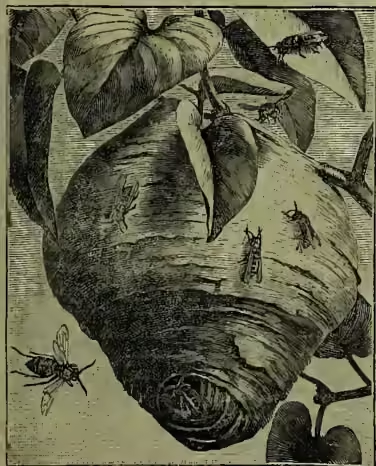
The social wasps—e.g. species of Vespa and Polistes—build papery nests which in intricacy and beauty of architecture rival the achievements of the live-bees. Begun by the queen-wasp, who alone survives the winter, and completed by those of her offspring who develop into workers, these nests are composed of masticated vegetable matter, generally woody fibres worked into a paste with the viscid secretion of the salivary glands. A variable number of combs, each one cell deep, are connected together by a scaffolding of the same material, and often surrounded by external walls with one door in aerial nests, usually with two in those which are built underground. The cells, which are used as cradles for the developing eggs and grubs, are hexagonal in outline, and their openings generally look downwards. The site of the nest is very varied: the Hornet (q.v.; Vespa crabro) usually chooses the hollow of a tree, the common wasp (V. vulgaris) builds in the ground, the wood-wasp (V. media) hangs its oval nest from the branches of a tree. Moreover, within one species there is no rigid adherence to one situation; thus the nests of the hornet and the common wasp are often built under the eaves of houses. Nor is the framework always of a papery texture, for some species of Polybia common in South America use earthy materials. In size too there is great variety, from a few inches in girth to five feet in length, and within the same species there are wide limits according to the strength and prosperity of the society.
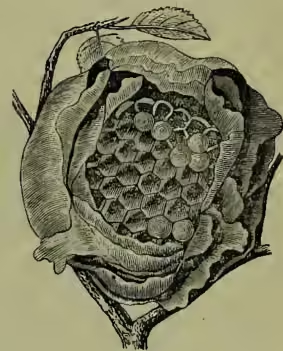
In illustration of the annual life of the social Vespidae, the history of the common British wasp may be outlined. As in other wasps of temperate countries, the sole survivor of the winter is a queen or female who has lain in shelter since her impregnation the previous autumn. In early spring she awakens from her torpor and seeks a site for the nest. A suitable hole is found, a foundation of wood-scrappings is laid, a foot-stalk is reared to support the first two or three layers of cells, these are covered by an umbrella-like roof, and an egg is laid in each. More cells are made, and more eggs are laid. As the first laid eggs hatch, the walls of the cells are raised in relation to the increasing size of the grubs, which eventually shut themselves in with a silken lid. During growth, however, they have required food—nectar from flowers, juices of fruits, honey stolen from the bees, and the like—and the mother-wasp has a busy life. But the period of pupation is short, and soon there emerge workers who lighten their mother's labours. They make more combs, the female lays more eggs, more workers are born, and, as autumn draws near, females and finally males. The young females and the males quit the nest in a nuptial flight which secures the continuance of the species, while the workers left in the nest evict the remaining grubs, and themselves await death. In some cases the story is complicated by the fact that the rudimentarily sexual workers may produce parthenogenetic eggs which develop into males. The food of wasps consists of the juices of plants, sweet fruits, the nectar of flowers, and honey-dew, but they are sometimes carnivorous, preying upon other insects, larvæ, spiders, and even on the corpses of larger animals. All who have sat at lunch in the country during a hot summer know with what pertinacious during the wasps which enter by the open windows attack not sweets only, but all sorts of palatable viands. Although wasps are very destructive of fruits, it must be noted in their favour that many of them destroy other insects, grubs, and caterpillars. The stinging-organ is, as usual, an ovipositor, and not of course possessed by the males. In structure and mode of action it generally resembles that of Bees (q.v.). The poison which enters the wound made by the sharp little instrument produces painful inflammation, especially in the case of hornets, but unless the stings be numerous injurious results are rare. It is well, however, to take means to allay the inflammation—e.g. by hot-water fomentations, or by the homely remedies of indigo-blue and soap and sugar, which are usually sufficiently effective.
The solitary wasps, also included in the family Vespidae, have no workers; they usually build single cells of clay or sand; and they are also distinguishable structurally from the social forms. Thus the mandibles are generally long and narrow, not broad, the tarsal claws are toothed, and so on. They are generally smaller than the social wasps, and darker in colour. The nest is oftenest in a hole, and is very generally provisioned with insects or insect-larvæ for the use of the offspring. A well-known representative is the Wall-wasp (Odynerus parietum), common in Britain and throughout Europe; it digs a hole in walls and builds a projecting tubular porch, at first straight, but towards the end bent downwards; the hole is stocked with paralysed grubs and caterpillars, and among these an egg is laid. Other common genera are Eumenes and Pterochilus.
Besides the Vespidæ there are, as has been already noticed, a number of families the members of which may be popularly called wasps. Thus there are the burrowing sand-wasps or Crabronidæ,—e.g. Sphex (q.v.), Ammophila, Crabro, Dinetus, Bembex; the nearly related Pompilidæ, with similar habits—e.g. Pompilius (one species of which preys upon the large spider Mygale), Priocnemis, Pogonius, Cercopales; the Heterogyna—e.g. Sapyga, which usurps the burrows of other insects, and Mutila, whose larvæ are parasitic in the nests of humble bees; the small golden wasps, cuckoo-flies, or Chrysidiæ—e.g. Chrysis—which lay their eggs in the nests of bees or wasps.
More distantly related to the wasps are those Hymenoptera in which the females have, instead of a sting, a boring ovipositor, by means of which the eggs are laid in other insects or in plants. Such are the Ichneumonidæ, Evaniidæ, Braconidæ, Chalcididæ, Cynipidæ, Uroceridæ, &c.
See BEES, INSECTS, SPHEX, STINGING ANIMALS; Lubbock's Ants, Bees, and Wasps; the continuation of Buffon (Par. 1836-46); Saussure on the Vespidæ (Par. 1852-57); and German works by Schenk (1861) and Taschenberg (1866).