Whale. The name may be taken as equivalent to Cetacean, and applied to any member of that order of mammals, which includes two great sets: the toothed whales, such as Sperm-whale and Dolphin, and the whalebone whales, such as Right Whale and Rorqual, in which the teeth are only embryonic. The general characters of the order are summed up in the article Cetacea (q.v.). The order Cetacea is usually divided into three sub-orders: (1) the Mystacoceti or Balænoidea, baleen or whalebone whales; (2) the Odontoceti or Delphinoidea, toothed whales; and (3) the Archæoceti or extinct Zeuglodonts. The differences between the extant sub-orders are so great that any idea of close relationship must be abandoned; their common ancestry must be far back, and indeed it is doubtful whether our classification might not be brought nearer the truth by recognising two distinct orders. Less specialised than the modern types are the extinct Zeuglodonts of the Eocene period, but it is by no means certain that they should be included within the order Cetacea.
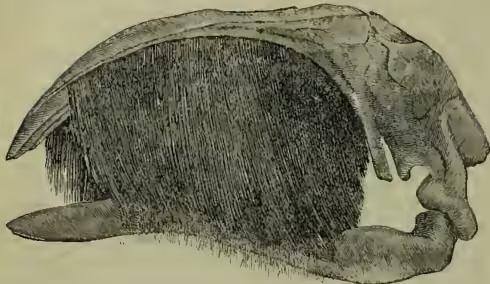
Baleen Whales.—Baleen consists of a double series of 300 to 400 horny plates, which grow from the palate and hang down into the mouth. Each plate is somewhat triangular, the base being rooted in the palate; both apex and inner edge are frayed into hairy shreds. These plates grow from parallel ridges on the palate, which are covered with long vascular papillæ. These papillæ become horny and fuse together to form the plates. The whale is wont to swim with open mouth through shoals of pelagic animals; having secured a good mouthful, it closes its jaws, raises its tongue, allows the water to strain out at the sides through the baleen plates, on the edges of which the food is caught. Thence it is swallowed. In short, the apparatus serves as a strainer or sieve.
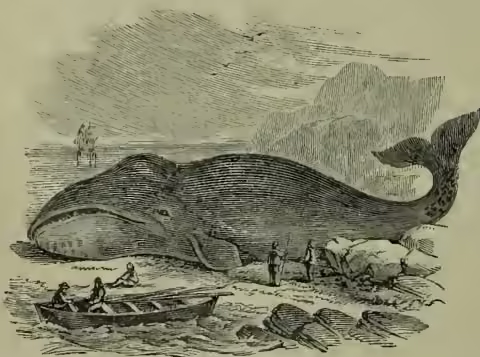
There are five extant genera of baleen whales, of which the best known are the Right Whales (Balaena) and the Rorquals (Balenoptera). In the genus Balaena the skin of the throat is smooth, there is no dorsal fin, the neck vertebrae are fused, the fore-limb is short, broad, and five-fingered, the head is very large, the baleen plates are very long, narrow, and black. The Greenland or Arctic Right Whale, or Bowhead (Balaena mysticetus), of circum-polar distribution, measures 45 to 50 feet in length, the head forming more than one-third of the whole. It surpasses every other species both in quantity of oil and in length, quantity, and quality of whalebone, a large example yielding 275 barrels of the former, and ton of the latter. The blubber may be 16 inches in thickness. The huge animal feeds for the most part on very minute crustaceans. The Southern Right Whale (B. australis) inhabits the temperate seas of both hemispheres, apparently with local varieties in different regions. In many ways it resembles the Arctic species, but has a relatively shorter head, shorter baleen, and a different body contour. The 'Humpback' (Megaptera boops) is about the same size as the Arctic right whale, but has the skin of the throat plaited, a low hump-like dorsal fin, free neck vertebrae, very long and narrow four-fingered pectoral limbs, a head of moderate size, short and broad baleen plates. It is common in the North Atlantic between Norway and Greenland, and occasionally visits British coasts. Other forms, perhaps of the same species, occur in the South Atlantic and in the Pacific. For Balenoptera, see RORQUAL. The two other extant genera of Balaenoida are represented by the rare Neobalaena marginata from Australian seas, the smallest of whalebone whales, not exceeding 20 feet in length; and Rhachianectes glaucus, the Gray Whale of the North Pacific, from 35 to 40 feet long.
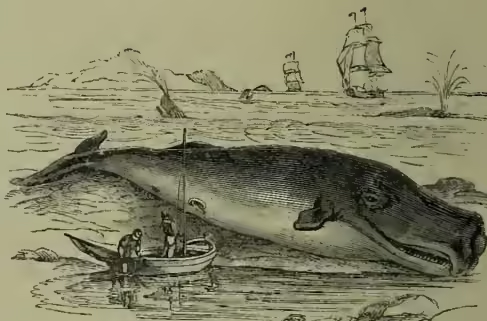
Toothed Whales.—The Odontoceti are represented by many more forms than the Mystacoceti, and there is a much greater diversity of type. The Cachalot, or Sperm Whale (Physeter macrocephalus), the only representative of its genus, is a huge Cetacean widely distributed in 'schools' in tropical and subtropical seas. 'The length of the full-grown male is from 55 to 60 feet, but the female is stated not to reach more than half that size.' The lower jaw bears on each side twenty to twenty-five strong, conical, recurved teeth, fixed in a long groove and not in distinct sockets; the shape of the skull is very unlike the shape of the head, for while there is a very long rostrum and a deep basin-like concavity on the upper surface of the skull, the head is rounded and truncated in front; the bulk of the head above the cranium consists of tough fat or 'junk,' but above this there is a large 'case' containing fluid oil and a granulated substance which yields 'spermaceti'; there is a very long mandibular symphysis; the head is about a third of the total length; the somewhat sigmoid blow-hole is at the anterior end of the head, slightly to the left side; the mouth is ventral behind the end of the snout, the lower jaw may be let down almost at right angles to the upper, and the gape is thus enormously wide; the throat, unlike that of the baleen whales, is also wide, sufficient it is said to admit a man's body; the pectoral limbs are short and broad; the dorsal fin is represented only by a low protuberance. The sperm whale feeds chiefly on cephalopods. The 'schools' may consist of hundreds, led by two or three large bulls; the females often endanger their own safety in aiding their offspring to escape; the bulls sometimes fight desperately with one another, or with their persecutors, and are said to sink not only boats, but even whaling vessels. Apart from oil and spermaceti, the cachalots yield 'ambergris,' an intestinal concretion of strong odour, formerly used in medicine, now restricted to perfumery. The Cachalot is not frequent on European coasts, but is said to have occurred in the Mediterranean, and has been occasionally stranded on British shores.
Within the same family as the sperm whale is the imperfectly known Cogia breviceps, a small whale about 10 feet in length, met with at various distant localities in the Southern Ocean, and also off the coast of Madras, and in the North Pacific; the 'Bottlenose' (Hyperoodon rostratus), regularly hunted in the North Atlantic, besides several other forms. Very remarkable are the fluviatile and estuarine Platanistidae, the blind Platanista of the Ganges, Brahmaputra, and Indus, Inia in the Amazon, and Pontoporia in the estuary of the Rio de la Plata. The Delphinidae are represented by numerous forms—e.g. the Arctic Narwhal (Monodon monoceros), remarkable for the enormous single tusk of the male; the Belnga (Delphinapterus leucas), a pure white Arctic whale occasionally coming as far south as Scotland and the St Lawrence; the Common Porpoise (Phocaena communis); the killer or 'Grampus' (Orea gladiator); the Caaing Whale (Globicephalus melas); the Common Dolphin (Delphinus delphis); and many others.
Whale 'Fishery,' as it is popularly called, seems to have originated in ancient times and independently in many parts of the world. Indians, Eskimos, Japanese, Tartars, and Norsemen were among the early whale-hunters. When the Atlantic right whale was still common, its pursuit was a recognised occupation of the seafaring folk of the Biscayan and Basque provinces, from the 10th to the 16th centuries. As whales became scarce in southern seas, the fishery moved northwards, and squabbles arose among the nations as to the various 'grounds,' which are now regarded as unrestrictedly international. The Dutch founded the settlement of Smeerenberg, in Spitzbergen, as a provisioning centre for the whalers and a melting-place for the whales; but by-and-by this was abandoned, for the whales were driven off and the fishery shifted to Greenland, whence the blubber was sent direct to Holland. In 1680 the Dutch had 266 ships and 14,000 sailors engaged in whaling, and for many years it was from Holland that the chief oil-supply of Europe was drawn. Soon, however, a decline set in, and towards the end of the 18th century the Dutch fishery had almost ceased. From 1732 to 1824 the British whalers were stimulated and subsidised by a government bounty of so much per ton, yet in 1815, when the British whale-fishery was in its most flourishing condition, only 164 ships were engaged in it. By 1828 the number had, however, fallen to 89 vessels, 49 of which were fitted out at Scottish ports. In that season 1197 whales were captured, the result being 13,966 tons of oil and 802 tons of whalebone. At present Dundee and Peterhead are the chief centres of the British whaling industry, but the number of vessels employed by the two ports is not more than 30. During the 18th century 'a new competitor had entered the field, and soon distanced all others.' In New York and Delaware, New England, and California whaling became an important industry, and as the whales retreated from persecution they were followed as far as Newfoundland. 'About 1750 the distant fishery was prosecuted with vessels of as much as 130 tons. New Bedford, destined to become the metropolis of the American whale-fishery, entered upon the business about 1755. In 1765 Boston had a hundred small vessels.' Towards the last quarter of the 18th century the whalers became more adventurous, and voyaged to the Brazil Banks, Cape Verde Islands, West Indies, &c., but further progress was stopped by the revolutionary war, and many American whalers sought fortune in Europe. 'The first whale-ship that ventured into the Pacific was sent from England in 1787, and was manned by Nantucket men. Subsequently the coasts of Chili and Peru and of East Africa were visited. In 1839 the American whale-fishery, having recovered from its temporary decline, boasted a fleet of 557 vessels. In 1846 the whaling-fleet consisted of 678 ships and barques, 35 brigs, and 22 schooners, but soon after this date the fishery began to decline.' (See Mr W. N. Lockington in the Standard or Riverside Natural History.)
Nowadays a whaler is a ship of 300 to 500 tons, with four or more five-oar boats, with an entire company of not less than thirty-five souls. There are hundreds of specialised appointments—e.g. windlasses for raising the blubber, boilers for 'trying' or melting the blubber, tanks for storing the oil. The crew are usually shipped on a profit-sharing system. A whale-boat is 28 to 30 feet by 6, sharp at both ends, and with sloping sides. It is manned by 'boat-header,' boat-steerer, and four men. It carries a long line coiled in one or two tubs, and arranged to run in a convenient manner when the harpoon to whose end it is fixed has struck a whale. And besides the essentials—harpoon and line—there are numerous accoutrements—e.g. lances, bomb-gun, and harpoon-gun. From a distance of about 3 fathoms the boat-steerer throws his harpoon, or more than one; if it strikes, the oarsmen back water vigorously to escape the not unfrequent blow of the whale's flukes. If the whale is fast, its behaviour regulates the working of the boat; but whether the victim 'runs,' or 'sounds,' or 'brings to,' the whalersmen do their utmost to get as soon as possible within range of lance or gun.
Economic.—As is well known, whales are chiefly valuable on account of the oil yielded by the blubber and the whalebone or baleen. Spermaceti and ambergris have a subsidiary economic importance. As to the oil, which was formerly the most remunerative result of whaling, it must be remembered that the use of gas and other modern illuminants has reduced the necessity of having oil-lamps, and that mineral and vegetable oils are now used for many purposes—e.g. 'batching' jute, for which whale-oil was once in great request. Still, however, the oil finds a ready sale, the sperm-oil of Physeter having a distinct precedence over the train-oil of the baleen whales. For whalebone, spermaceti, ambergris, see separate articles.
It must be admitted that although great prizes are sometimes won by the whalers, the fishery is somewhat of a lottery. Apart from the dangers of shipwreck, exposure, and starvation, now happily diminished, the vessel may come home 'clean,' or without a single fish. It is recorded that a Peterhead whaler once captured in one season forty-four whales, and returned with a cargo of oil and whalebone valued at over £10,000; and that the Arctic of Dundee, under Captain Adams, once brought home the produce of thirty-seven whales, including about 18 tons of baleen. Even in those days this was exceptional; now very poor 'fishings' are more usual, and Dundee ships have, without much success, tried the Antarctic. On the other hand, the scarcity has raised prices, and a really successful trip yields large returns. The Arctic came home to Dundee in 1895 with the produce of ten whales, including 5 tons of bone (some of which sold at £2000 per ton) and 90 tons of oil—the total return being 360 per cent. on the outlays. It may be doubted whether the results of the fishery justify the persecution of the unfortunate whales.
See AMBERGRIS, BELUGA, BOTTLEHEAD, CAAING WHALE, CETACEA, DOLPHIN, GRAMPUS, NARWHAL, OILS, PORPOISE, RORQUAL, SPERMACETI, &c.; W. H. Flower and R. Lydekker, 'Introduction to the Study of Mammals' (1891); Brehm's Tierleben (3d ed. vol. iii. 1891; Standard or Riverside Natural History (ed. by J. S. Kingsley), 'Cetacea,' by W. N. Lockington (Lond. 1888); Cassell's Natural History (ed. by P. Martin Duncan), 'Cetacea,' by J. Murie; J. Hunter, 'Observations on Structure and Economy of Whales,' Phil. Trans. (1787); W. Scoresby,
Journal of a Voyage to Northern Whale-fishery (Edin. 1823); T. Beale, Nat. Hist. of Sperm Whale (Lond. 1835-41); J. E. Gray, Zoology of 'Erebus' and 'Terror' (Lond. 1846); D. F. Eschricht, Unters. über die Nordischen Wallthiere (1849); H. T. Cheever, The Whale and his Captors (New York, 1850); J. E. Gray, Cat. Seals and Whales, Brit. Mus. (2d ed. 1866; supplement, 1871); W. H. Flower, Recent Memoirs on Cetacea (Ray Soc., 1866); P. J. van Beneden and P. Gervais, Ostéographie des Cétacés (1869-80); Sir Wm. Turner, Trans. Roy. Soc. Edin. (1870), and numerous other papers; T. Bell, Hist. Brit. Quadrupeds, including Cetacea (2d ed. Lond. 1874); C. M. Scammon, Marine Animals of N.W. Coast of N. America (San Francisco, 1874); W. H. Flower, 'Characters and Divisions of Delphinidae' (Proc. Zool. Soc., 1883); G. B. Goode, Fisheries of U.S.: I. Whales and Porpoises (Washington, 1884); J. Struthers, 'Anat. of Megaptera' (Jour. Anat. Physiol. 1887-89, 1891); P. J. van Beneden, Hist. Nat. des Cétacés des Mers d'Europe (1889); F. W. True, 'Review of Delphinidae' (Bull. U.S. Mus., 1889); D'Arcy Thompson, 'Systematic Position of Zeuglodon' (Stud. Mus. Zool. Dundee, 1890); W. Kükenthal, 'Adaptation of Mammals to Aquatic Life' (Trans. Ann. and Mag. Nat. Hist., 1891).
WHALEBONE consists of the baleen plates of the Arctic and allied whales. They are, however, not bone at all in the ordinary sense of the word, but consist of an epidermic substance more resembling hair in its nature. The baleen, which occurs in triangular plates, only requires to be scraped and softened, by boiling it for ten or twelve hours, to bring it into a proper condition for use. It is then cut into strips of various sizes for the market. For some purposes whalebone excels in usefulness any other known substance, as it has great flexibility combined with lightness and strength; but its toughness, the ease with which it can be split, and its power to stand without change a heat considerably above ordinary temperatures add to its value. The high price which whalebone has reached precludes the possibility of its being used so extensively as it was in former years. It is still made into brushes for street-sweeping machines, for cleaning flues, and for other purposes in which they are subjected to much wear and tear. Dressmakers and milliners also employ it to a limited extent. Steel wires, as they take up less room, took the place of whalebone for umbrella frames about the middle of the 19th century. The earlier whalebone umbrella-stretchers were as much like spokes of wheels as wires. For other purposes steel, vulcanite, and cane are substitutes for whalebone, but in some cases only indifferent substitutes. The lowest price of whalebone during the 18th century was £350 per ton, but early in the 19th it had fallen to £25, and even as late as 1868 did not fetch more than £40. In 1882 it had advanced to £1150, and in August 1892 it had reached the very high figure of £2925 per ton. This, however, is for dry whalebone a year old. New whalebone, which is not so free of moisture, is worth about £2500 per ton. Nowadays an average sized Arctic whale yields about 10 cwt. of whalebone, but in former years ton was occasionally obtained from a single 'fish.'