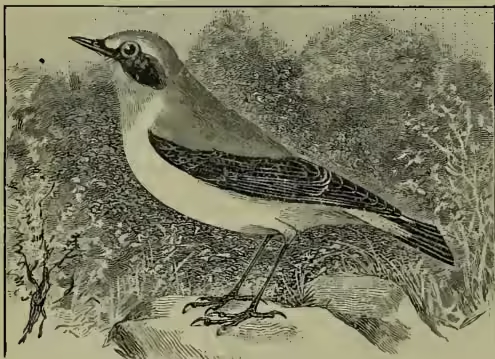
Wheat-ear (Saxicola ænanthe), a bird of the Chat genus (q.v.). It is one of the first spring visitors to the British Islands, and although gener- ally and widely diffused it is still a local bird in most places. In the south and west of England it is somewhat rare; in the north it is commoner; while in the Orkneys and Shetland and the Outer Hebrides it is one of the commonest and most abundant birds. It breeds throughout central and northern Europe, and in southern Europe where the mountains are high enough for pine and birch; westwards to Iceland, Greenland, and Labrador; eastwards to Persia, Syria, North Siberia, and Alaska. Its winter migrations extend southwards to North and West Africa, Mongolia, Northern India, Persia, and the Bermudas and Colorado. It nests about the middle of April, and produces two broods of from five to seven young in a season. It feeds on insects, grubs, worms, small spiders, and small snails. It is a good mimic, and the song of the male is rather pretty. The most striking character of the plumage is the white colour of the rump, upper tail-coverts and base of the tail, whence the name white rump, by which the bird is known in every European language, and of an Anglo-Saxon equivalent of which 'wheat-ear' is believed to be a modern corruption—though it is thought by some to be for whitterer, meaning twitterer. The wheat-ear migrates at night, and in autumn when the birds are fat and of rich flavour they used to be snared in great numbers by shepherds, and sent to the London and other markets. Of late years they have become much less plentiful, owing probably to the destruction of their favourite breeding-grounds by cultivation. The wheat-ear is also known by the names fallow-finch, white-tail, stone-chucker, chack-bird, &c. They arrive in Britain in two divisions, the first, in March, consisting of poor, emaciated birds, the second, a month later, of plump ones. The Isabelline Wheat-ear (S. isabellina) has been found only once in Britain. It differs from the common wheat-ear in being larger, more tawny, in having a shorter tail with more black in it, and the under wing much lighter. The Black-throated Wheat-ear (S. stapazina) and the Desert Wheat-ear (S. deserti) have been found in Britain only once or twice.