Whelk, a popular name for a number of marine Gasteropods, and especially applied to species of Buccinum common on the coasts of northern seas. Very familiar is Buccinum undatum, the 'common whelk,' often dredged for bait or as food for the poor. It occurs from low-water to a depth of about 140 fathoms, and burrows in the sand for bivalves, such as Mya, on which it feeds. Its shell is sometimes 3 inches in length, is grayish or brownish-white in colour, and has a few ridged whorls, a wide aperture, and a short notch or canal for the respiratory siphon. The animal has a strong radula with which it can bore through shells, a markedly protrusible mouth, a long protrusible siphon through which water enters the gill-chamber, and a plate-like horny operculum borne by the foot.
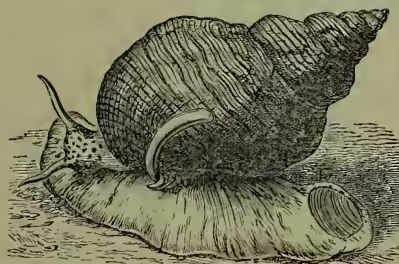
The notch at the mouth of the shell, in which the siphon lies, is characteristic of most carnivorous Gasteropods. The egg-capsules, which are aggregated in balls, are often seen attached to the rocks or drifted on to the sand. Each capsule contains a large number of eggs, but only a few of the embryos survive, as the result, it is said, of juvenile cannibalism. In Scotland Buccinum undatum is often called the Buckie, but the 'roaring buckie' is Fusus antiquus, a related form, which has a much longer siphon canal. The name 'dog-whelk,' or 'dog-periwinkle,' is given to Purpura lapillus, a small form very common among the rocks and very destructive to mussel-beds. It secretes a white fluid, which on exposure to air becomes a brilliant blue. Its egg-capsules are also common on the rocks, and look like little vases standing erect in clusters. Another common 'dog-whelk' is Nassa reticulata, abundant on the low-water rocks.
All these must be distinguished from the most edible whelk—the Periwinkle (Littorina littorea), a vegetarian Gasteropod not nearly related to the above. For anatomy, see GASTEROPODA.—Whelk is also an old name for Aene (q.v.).