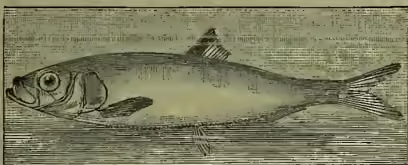
Whitebait, the name by which the fry of the Herring (Clupea harengus) and Sprat (Clupea sprattus) are known in the market, and when served for the table, especially in London. It was formerly regarded as a distinct species of the family Clupeidae, and was called by Cuvier and Valenciennes Rogenia alba, by Yarrell and several other British naturalists, Clupea alba. Its true nature has long been definitely established, and it is by no means difficult to recognise in specimens of whitebait the characteristic specific characters of herring or sprat as the case may be. Whitebait fishing in the Thames is carried on chiefly from February to August, and it has been found that in February and March only 5 to 7 per cent. of the fish were herring-fry, 93 to 95 per cent. being young sprats, while in June and July the proportions were reversed, 75 to 87 per cent. being herrings, and the remainder sprats. The length of these little fish is from 1 to 3½ inches. The sprat spawns in the Thames from April to June, and the youngest fry, about two months old, are first taken in June. The smallest herring-fry in Thames whitebait are also about two months old, the larger as much as six months, while the largest sprats are probably nine months old. Whitebait are also taken in the estuary of the Forth between Alloa and Kincairdine, and in the estuary of the Exe in Devonshire, but in the latter county such fry are locally known as britt. Whitebait are almost always taken in stow-nets or bag-nets, large funnel-shaped nets fixed to the rope by which the fishing-boat is moored. The boat is stationary in the tide-way, the fish are carried by the tide into the open mouth of the net, and collect in the small-meshed blind, or cod-end of the net. The fry of the herring and sprat occur in abundance at the mouths of rivers and in tidal estuaries wherever the adults are numerous in the neighbourhood. Shad-fry (C. finta and alosa) also sometimes occur with the young of sprats and herrings.
For the table whitebait (the blanchaille of
English hotel menus) are fried with flour or crumbs; they are often laid on a napkin and sprinkled with fine flour and a little salt, rolled about till well covered with flour, and then thrown into a pot of boiling lard, where they remain till they are of a pale straw colour. Londoners resort to Greenwich and Blackwall to enjoy whitebait dinners. Towards the end of the 18th century it became the practice for the cabinet ministers to repair to Greenwich for a whitebait dinner every year before the prorogation of parliament in autumn—a practice revived by the Disraeli government in 1874 after its discontinuance by their predecessors, and since carried on with some intermissions. Some of the corporations of London indulge in a similar annual festivity, and the town-council of Exeter have also an annual dinner of which 'britt' is the characteristic feature.